RFP template: Choosing AI technology for enterprise customer service
An Excel sheet containing 100+ detailed evaluation questions across seven categories in scoring-ready format you can send directly to vendors.
Learn More

Gaming customer service doesn't slow down. Neither do player expectations.
Support queues fill up with the same recurring workflows: loyalty balance questions, account verification failures, wallet discrepancies, bonus eligibility checks, rules clarifications. Players expect immediate solutions to these issues, wherever they are, at any hour.
AI customer service agents change that. They resolve high-volume, repeatable work instantly and consistently, giving players the immediate answers they expect while freeing teams to focus on higher-impact moments.
This post is part of our AI agent in the field series , where we look at how AI customer service agents support real customer service teams in production. In this edition, we break down five gaming workflows teams are already automating today.
In gaming, the highest-volume conversations tend to sit at the intersection of player frustration and platform complexity. Players reach out because something doesn't add up—a missing bonus, a verification loop, a wallet balance that looks wrong—and they need a fast, confident answer.
The challenge for CX teams isn't answering these questions in theory. It's resolving them accurately, at any hour, against a constantly shifting backdrop of promotional calendars, payout rules, and compliance requirements.
The best workflows to automate first share a clear profile:
This is where AI customer service agents deliver real value. When guided by structured Playbooks, they can verify the right data, take the right action, and escalate when needed, resolving repeatable work consistently and safely at scale.
Below are five AI customer service workflows that teams are automating with AI agents to reduce support pressure and strengthen player retention.
These aren't edge cases. They're the workflows that flood support queues every day and quietly determine whether a player stays or churns.
Loyalty program inquiries are one of the most frequent and most retention-critical conversations in gaming. Players invest real time and money building status on a platform, and when they can't see where they stand or access what they've earned, that investment starts to feel invisible.
These questions come in constantly:
When these questions are handled slowly or inconsistently, they signal to players that the platform doesn’t value player activity. When handled well, they reinforce engagement.
With a loyalty Playbook in place, an AI agent can:
Because the agent follows a structured workflow, every player gets the same fast, accurate experience, regardless of channel or time of day. For platforms where loyalty drives retention, this is how AI customer service agents directly support lifetime value.
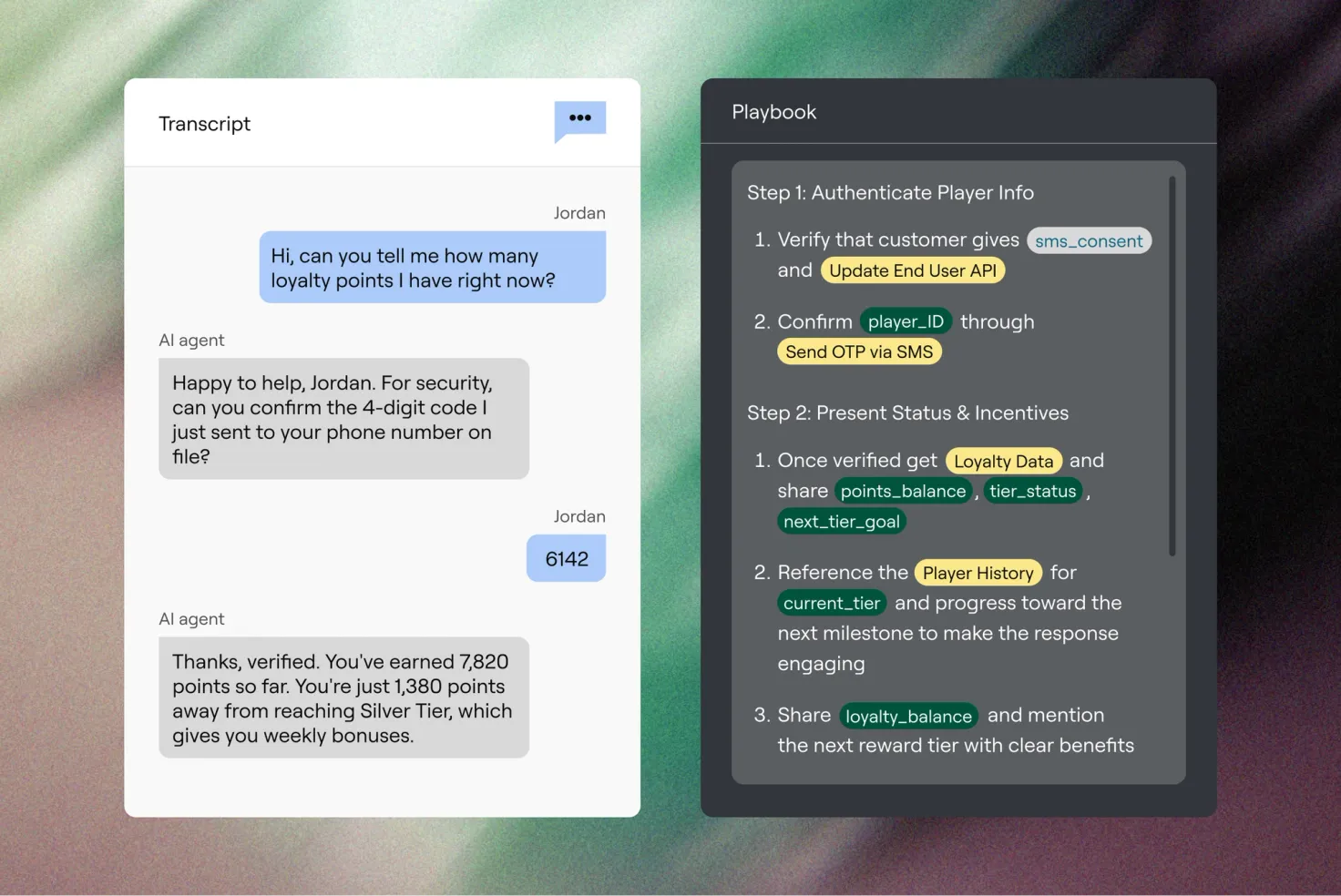
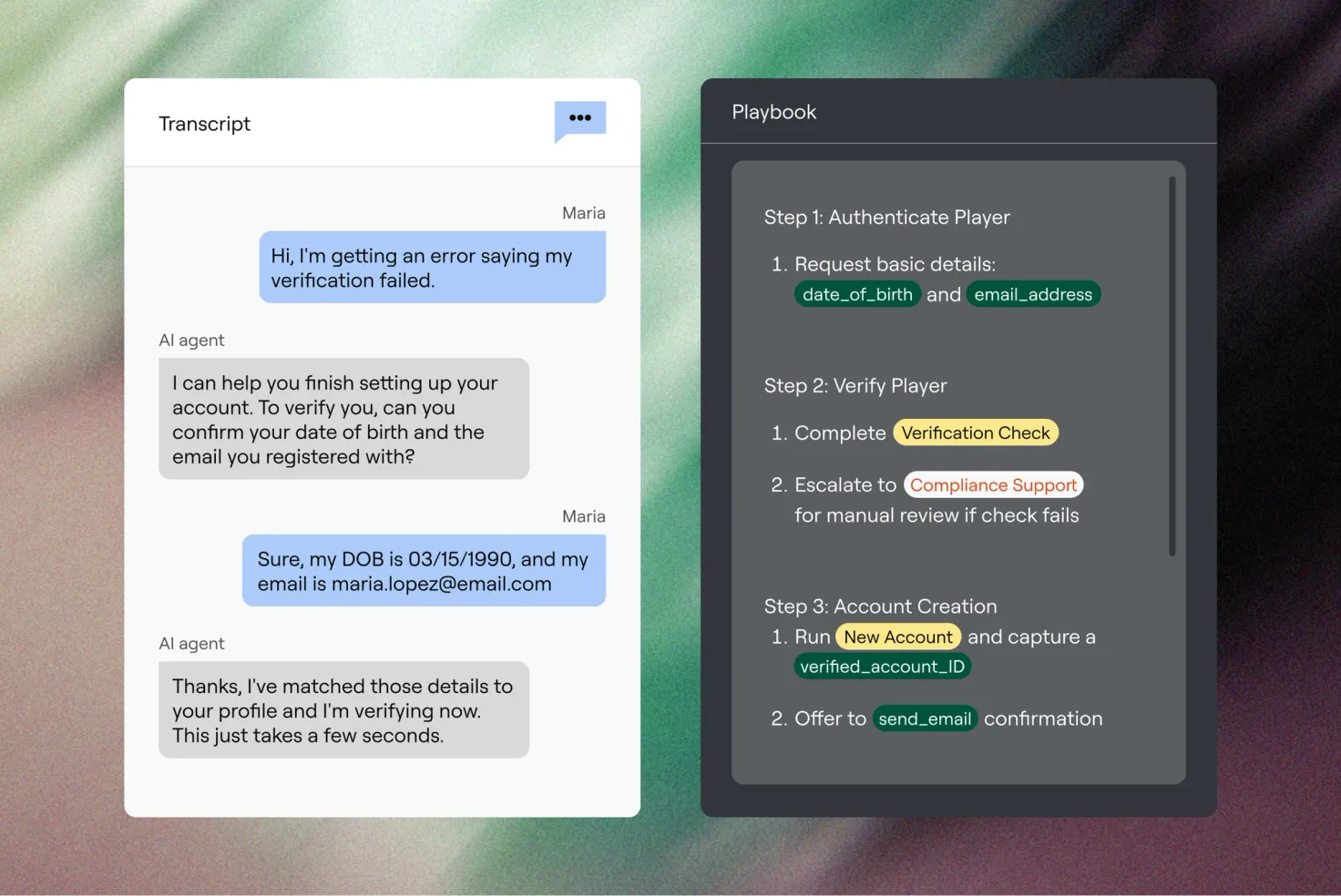
Account creation and verification is the first experience a new player has with a platform and it sets the tone for everything that follows. KYC failures like verification loops, unclear error messages, slow compliance checks push players away before they’ve placed a single bet.
Regulatory requirements are strict and tightening. Compliant, low-friction verification is business-critical. Yet it remains one of the most common drop-off points in the player journey.
Players stuck in these flows ask:
With an account creation Playbook, an AI agent turns this from a friction point into a confidence moment. The agent can:
Every step follows regulatory guardrails. Players complete verification faster, and CX teams avoid a bottleneck that doesn’t scale with volume.
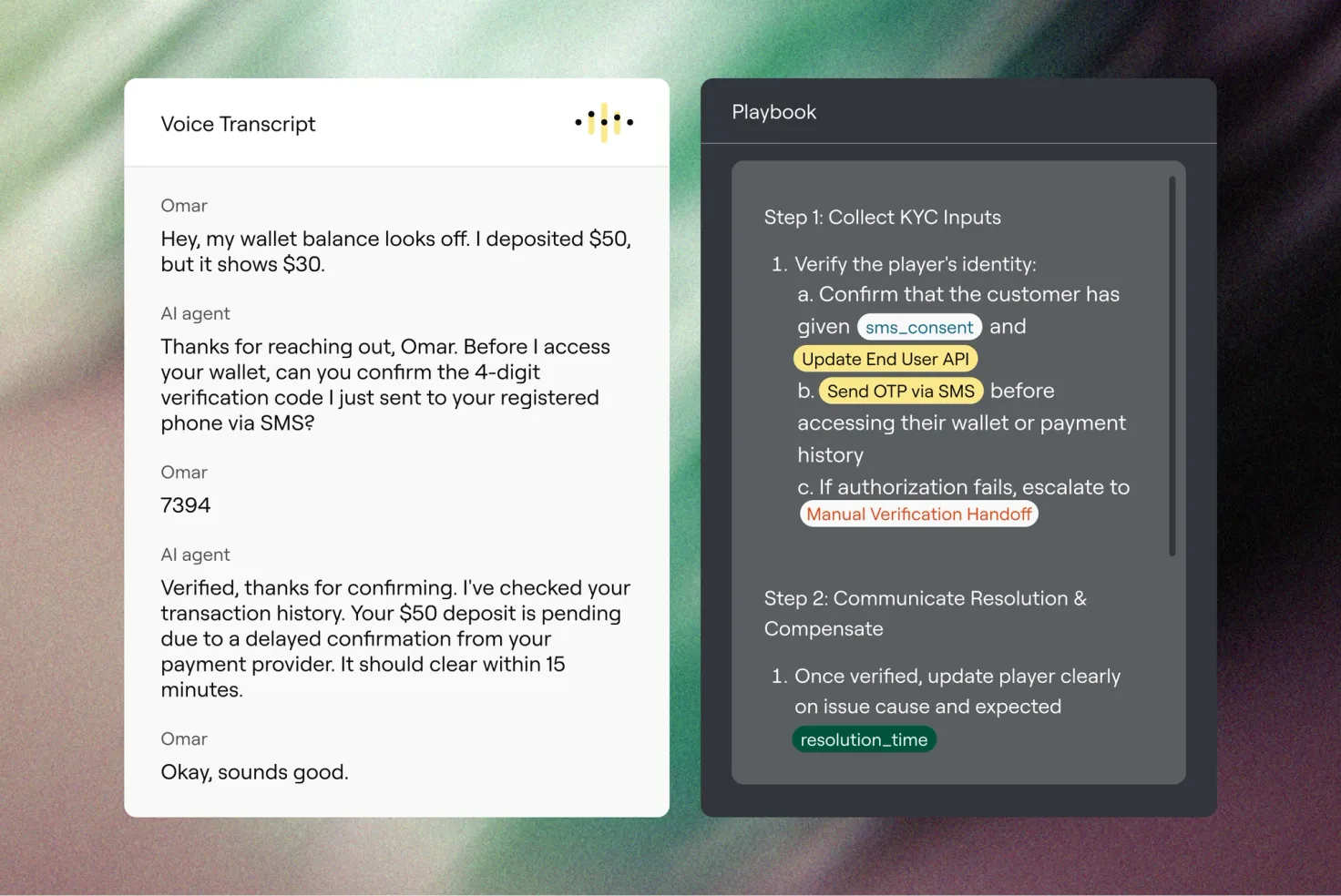
Balance discrepancies , like when a deposit doesn't appear, a payout looks wrong, or a wallet balance doesn't add up, create immediate distrust. Left unresolved, they quickly become churn events.
These moments require fast, confident answers backed by real transaction data. Manual investigation is too slow and inconsistent to handle them at scale, making it ideal for AI customer service.
With a balance discrepancy Playbook, an AI agent brings structure exactly when players need clarity. The AI agent can:
When an issue falls outside the agent’s scope, such as unusual patterns or fraud flags, it escalates automatically to a human.
For players, the experience shifts from uncertainty to resolution. For teams, it removes a high-effort contact type that depends on deep back-end access.
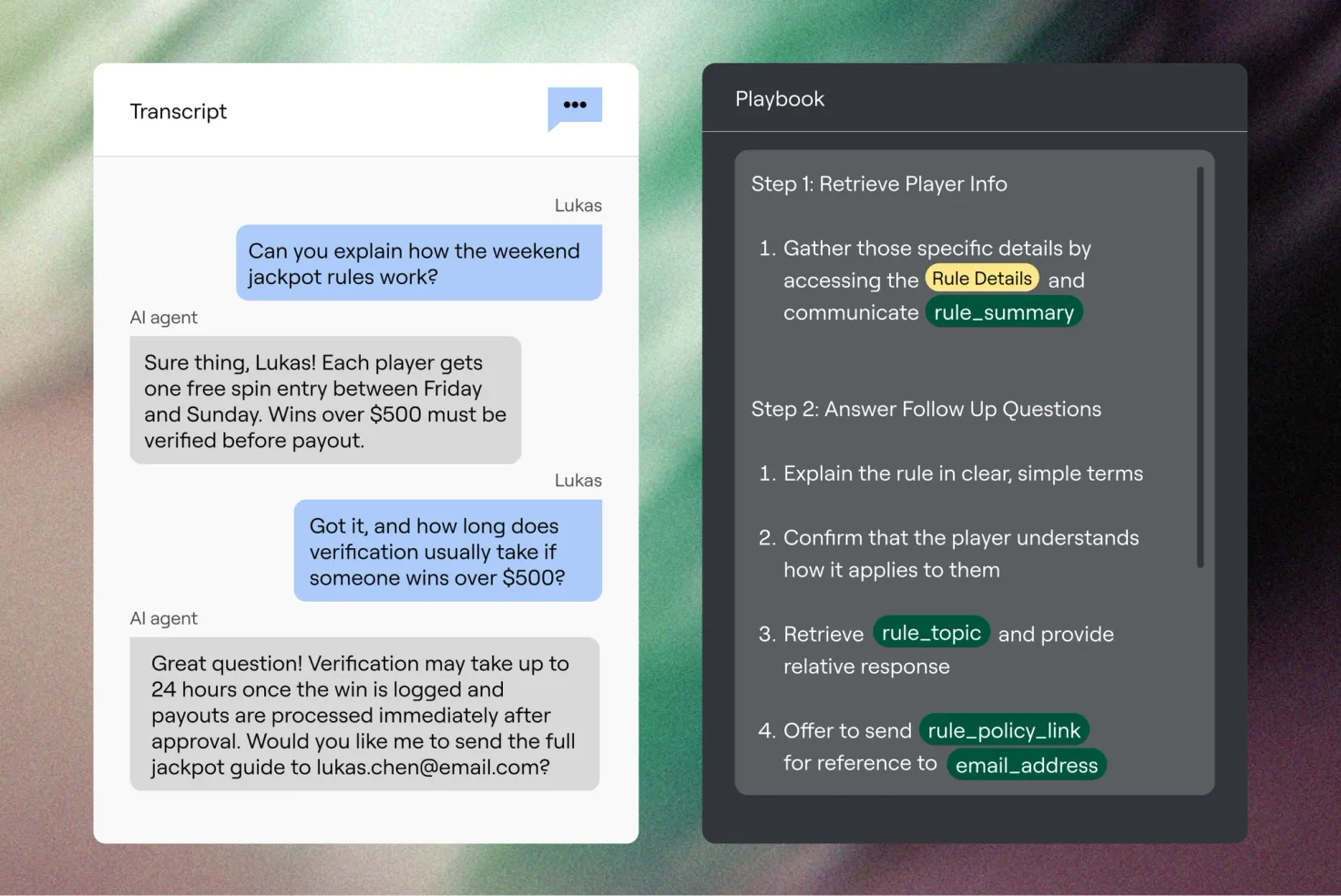
Rules clarification requests are constant, driven by the genuine complexity of jackpots, wagering requirements, payout windows, and promotional terms. When answers are unclear or inconsistent, trust erodes, and support teams take on avoidable risk.
Players ask:
With a rules clarification Playbook, an AI agent delivers accurate, consistent answers grounded in official policy. The agent can:
Because the agent references official rules at every step, responses stay accurate and defensible, reducing both ticket volume and downstream disputes.
Reward and promo eligibility questions are among the highest-volume contacts in gaming support. Complex terms—deposit requirements, wagering thresholds, expiration windows—create real confusion for players.
At the same time, platforms need eligibility logic that’s strict enough to prevent abuse and transparent enough to build trust.
Players ask:
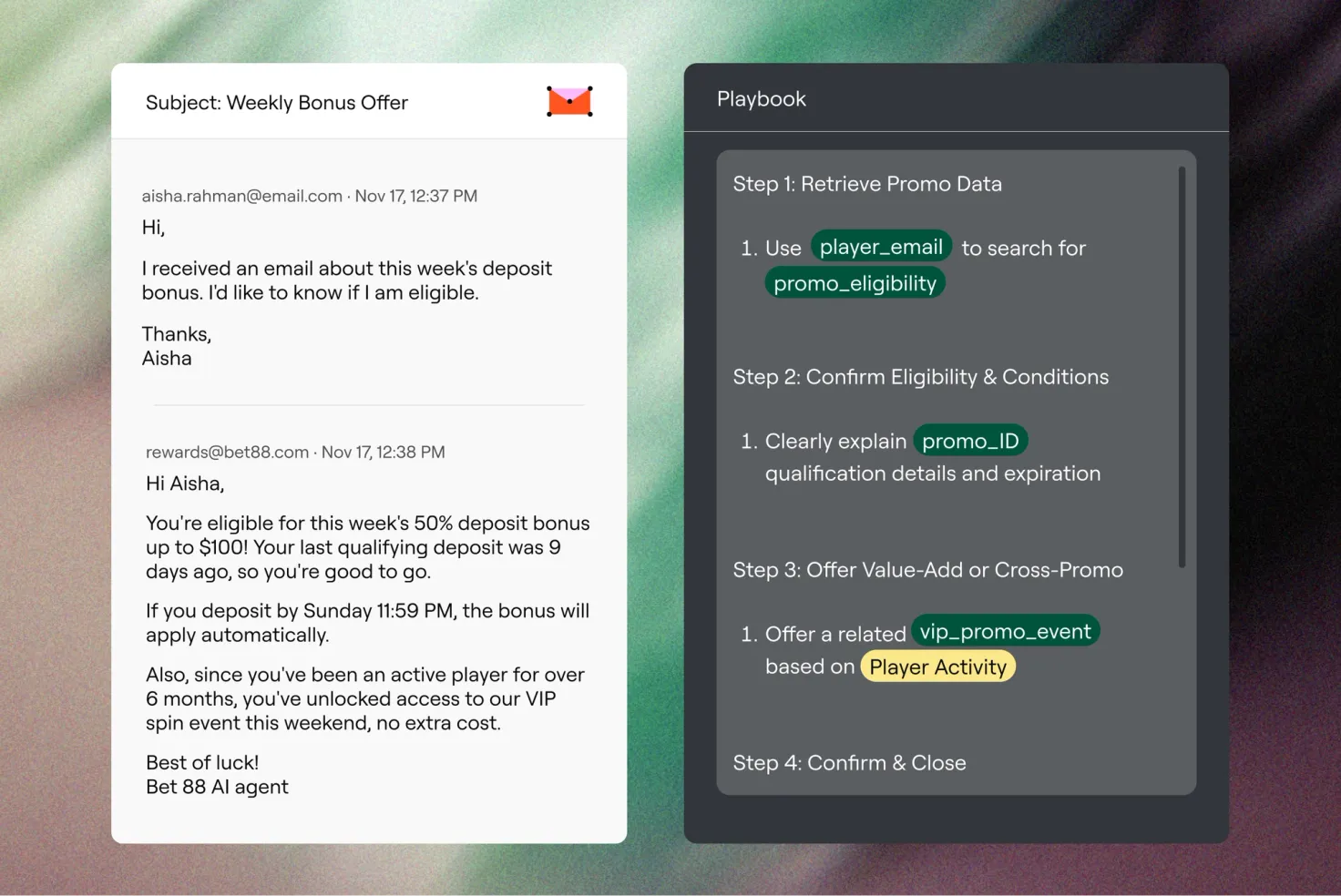
With a promo eligibility Playbook, an AI customer service agent turns this into a structured, governed workflow. The AI agent can:
Every eligibility check follows the same logic, every time. Players get clear, consistent answers and a moment of real value.
Promo abuse is controlled through automated guardrails, not inconsistent manual review. And support teams avoid a category of contacts that can dominate queue volume without requiring complex resolution.
Gaming platforms improve player support by automating the workflows that drive the highest volume and the greatest risk to player trust.
The five use cases above share the same profile: high-frequency, structured logic, and real-time system access required for resolution.
Effective AI customer service agents don’t approximate answers or redirect players to FAQs. They authenticate, retrieve live data, apply policy logic, and resolve the interaction—or escalate when needed.
59% of consumers prefer always-on, 24/7 AI support over waiting for a human, but only when it actually resolves their issue. In a 24/7 environment like gaming, that distinction matters. The standard isn’t just availability. It’s resolution.
That’s the difference between surface-level automation and AI customer service agents that support player retention at scale.
There’s a common assumption that consumers are skeptical of AI in customer service. The data says otherwise. Our 2026 report surveyed 2,000 consumers to understand how people actually experience AI in customer service today.
Read report
Knowing which workflows to automate is the starting point. Executing them safely—within compliance requirements, with consistent accuracy across every channel—is what separates early experimentation from lasting impact.
That’s where Playbooks come in.
Ada’s AI customer service platform and its Playbooks for gaming turn high-volume player interactions into structured, governed workflows with defined steps, system integrations, and clear escalation logic. When an AI agent verifies identity, resolves a balance issue, or confirms eligibility, it follows the same operational guardrails every time, across voice, messaging, and email.
Leading gaming platforms are operationalizing AI agents in the workflows that drive retention, compliance, and lifetime value.
When your highest-volume interactions are structured, governed, and continuously improved, your service model becomes more resilient. And in a category where player trust is earned one interaction at a time, that resilience becomes a competitive advantage.
Browse real examples of AI agents using plain-language instructions to automate multi-step processes with speed and precision.
Explore Playbooks Library