
RFP template: Choosing AI technology for enterprise customer service
An Excel sheet containing 100+ detailed evaluation questions across seven categories in scoring-ready format you can send directly to vendors.
Learn More

When customers contact their bank or financial services provider, it’s rarely casual.
They’re trying to move a repayment date before it’s too late, looking for a deposit that hasn’t landed, report a missing card, or are locked out of their account. These moments are emotional and time-sensitive, and they require precision.
That’s why A I in financial services can’t be reactive or experimental. It has to execute with structure.
This post is part of our AI agent in the field series: a look at how real AI customer service agents support real customer service teams in production. In this edition, we’re spotlighting five high-impact financial services workflows that banks and fintechs are automating right now.
These aren’t simple FAQs. They’re governed, API-connected workflows that reduce cost-to-serve while protecting trust. Let’s dive in.
For banks evaluating how to use AI customer service in financial services , the highest-impact starting point is automating structured, policy-driven workflows. The use cases directly answer questions like, “How can banks use AI to improve customer service?” and “What customer service workflows are safe to automate in financial services?”
In financial services, the highest impact workflows usually share three characteristics:
Think about the questions customers actually ask:
Each one touches risk, compliance, or retention.
With conversational AI in financial services, these interactions become structured workflows. The AI customer service agent doesn’t guess or improvise. It authenticates, retrieves real-time data, applies policy rules, executes approved actions, and confirms outcomes consistently across voice, messaging, and email.
When knowledge, policy logic, and live system data are coordinated in real time, these workflows remain accurate, brand-safe, and compliant, even as complexity increases. That’s what turns AI from a helpful assistant into a dependable part of your service operation. The five workflows below are where that shift matters most.
This ready-to-use RFP template helps you evaluate vendors with clarity. Without a structured evaluation framework, it’s easy to miss the questions that matter most. This template ensures you don’t.
Get the template
These workflows drive daily volume. During periods of economic pressure, fraud spikes, or regulatory change, they increase quickly.
These are the use cases that sit at the intersection of customer urgency and operational complexity. When they break down, queues grow, and trust erodes. Stabilize them, and you stabilize your service model.
Repayment flexibility is both a customer need and a risk lever. When customers anticipate a missed payment, they reach out looking for certainty:
This is one of the most common and policy-driven AI use cases that banks automate first.
Behind a simple request sits operational complexity: eligibility checks, cutoff rules, account status validation, and policy enforcement. Handled manually, these requests consume agent time and introduce inconsistency.
With AI in financial services, the workflow becomes structured. An AI agent can:
Instead of escalating every request, the AI agent follows guardrails. Customers get clarity immediately. Operations teams maintain compliance and control.
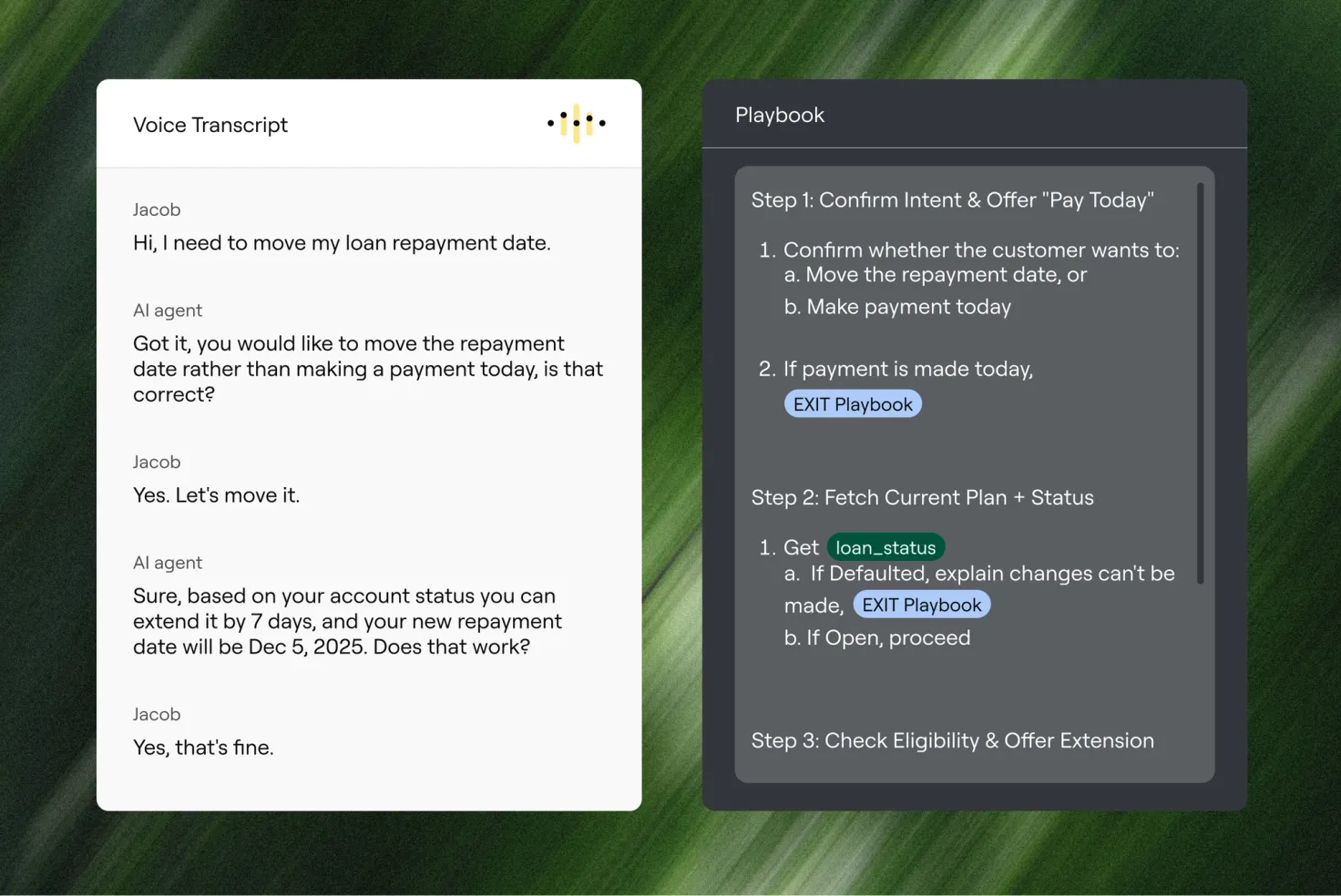
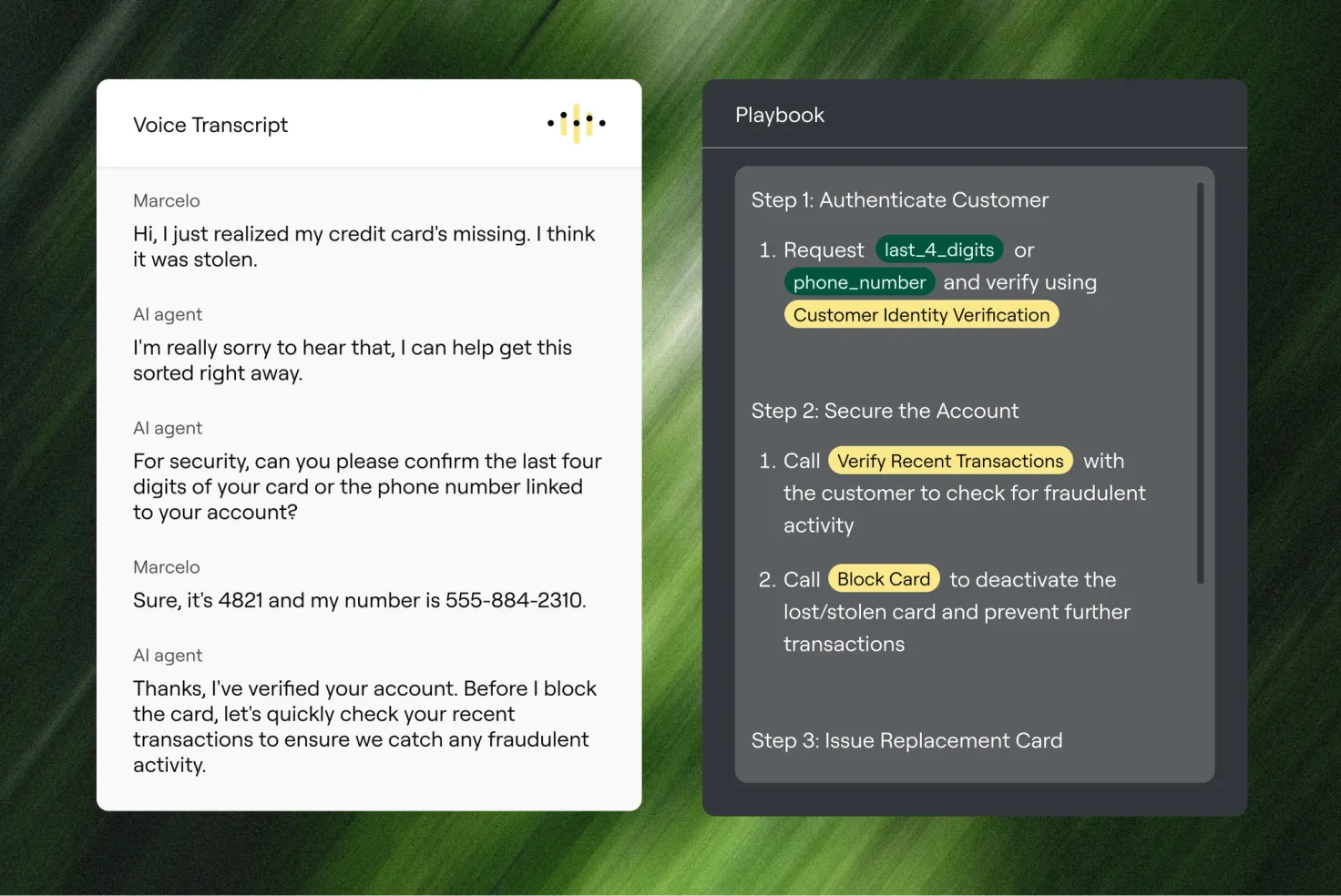
Few interactions are more urgent than a missing card.
These cases require secure authentication, manual transaction review, fraud validation, card blocking, and replacement issuance, often across multiple systems.
Conversational AI in banking can unify that flow. An AI agent can:
These high-stress interactions often come in over the phone. Here's how an AI agent turns a high-stress moment into an end-to-end resolution , without routing the customer through multiple queues.
For financial institutions, it reduces fraud exposure and inbound call spikes. For customers, it reinforces trust at the exact moment it’s tested.
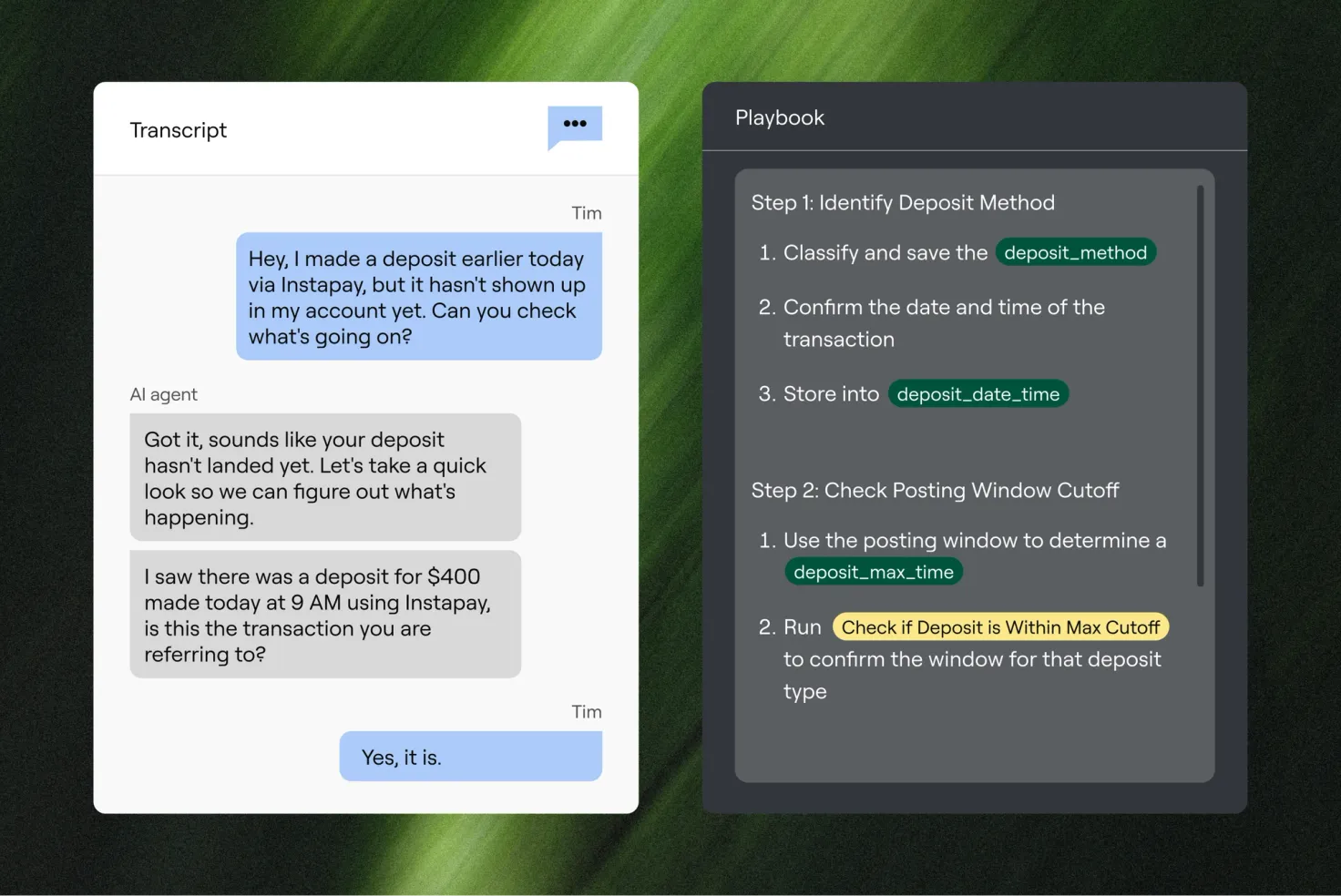
Deposit timing varies by method. Posting windows differ. Cutoff times matter. Holidays shift timelines.
When customers ask, “Where is my money?”, they’re not looking for a generic answer. They want a specific timeline tied to their transaction.
Without AI customer service, these requests trigger manual lookups and repeat contacts. With AI in financial services, deposit investigations become predictable, rules-based workflows.
An AI agent can:
If the deposit falls outside the expected window, the workflow escalates automatically. Instead of uncertainty, customers receive transparency. Instead of repetitive manual checks, teams regain capacity.
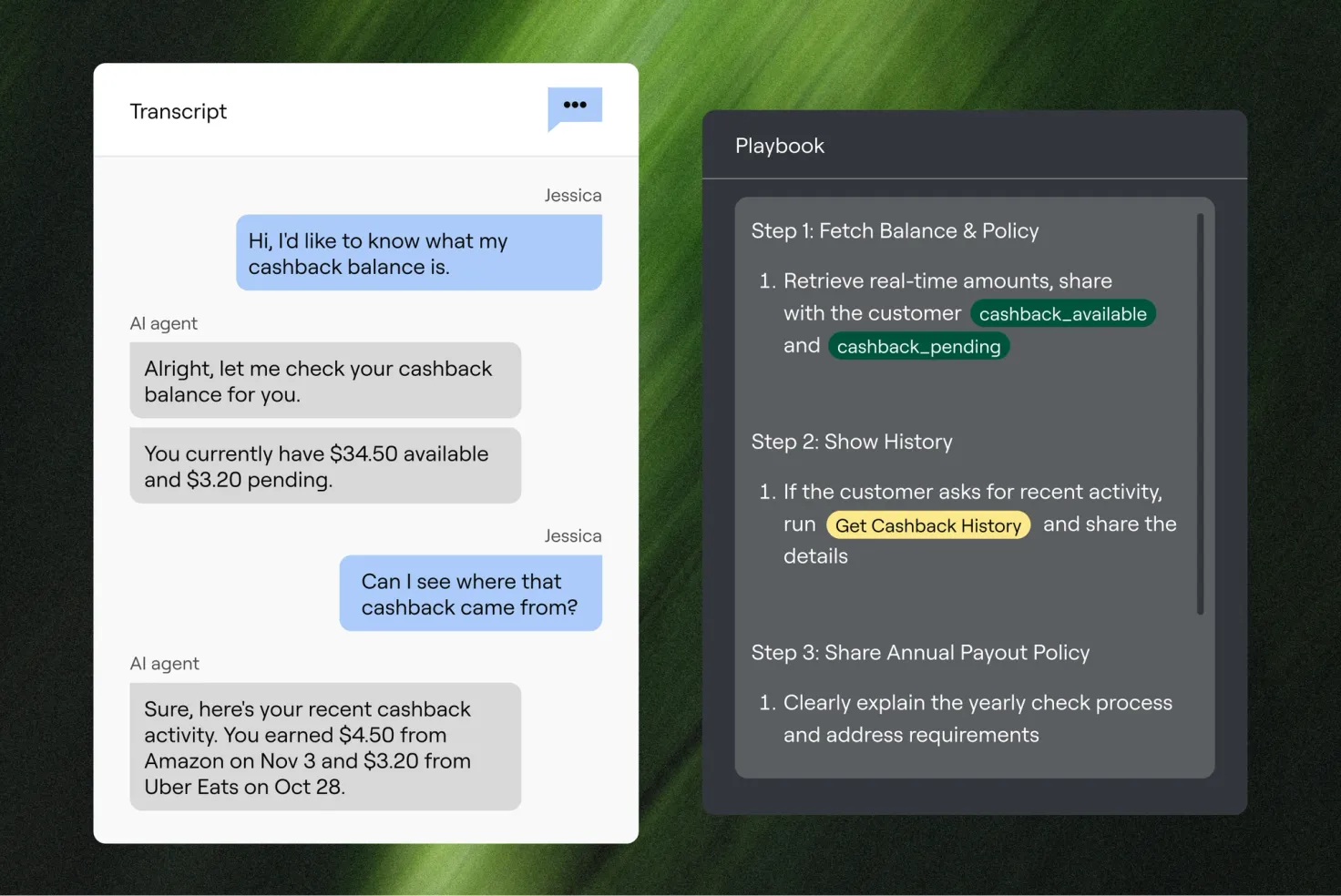
Rewards programs quietly drive retention—if customers can see and use their benefits.
Questions like, “What’s my cashback balance?” or “Where did these rewards come from?”are frequent and repetitive. With conversational AI in financial services, AI agents provide real-time visibility without human agent intervention.
An AI agent can:
When generative AI in financial services is grounded in real account data and governed workflows, it strengthens loyalty initiatives while maintaining precision.
Access issues are constant in digital-first financial services. Customers get locked out. Reset links expire.
These interactions require strict identity verification and secure delivery. When structured properly, AI banking can handle this safely.
An AI agent can:
This reduces routine workload while maintaining enterprise-grade safeguards. Customers regain access quickly. Risk posture remains intact.
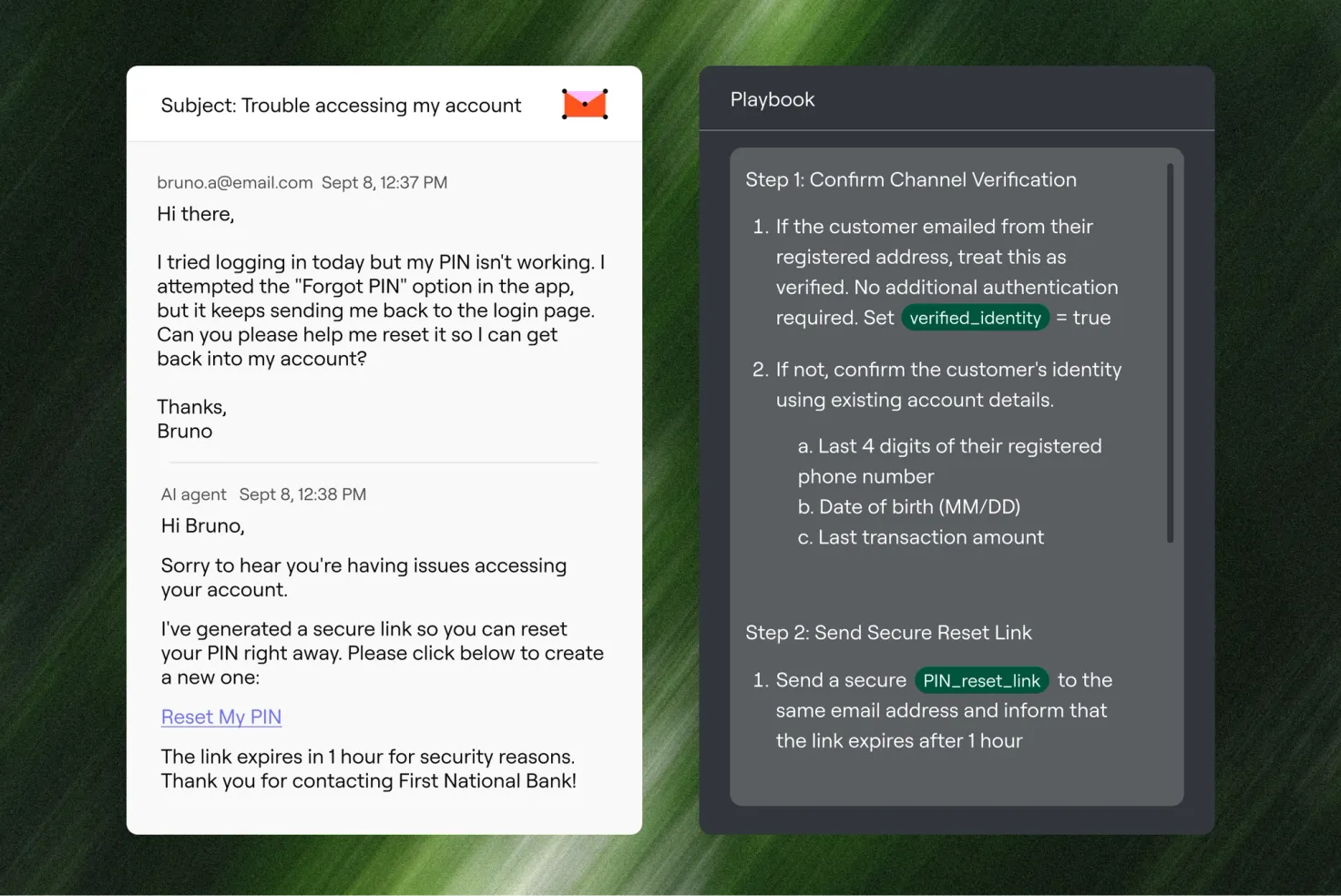
Knowing which workflows to automate is only the first step. Knowing how to automate them safely, consistently, and at scale is what drives impact.
That’s where Playbooks come in.
Playbooks turn high-volume financial services interactions into defined workflows with clear steps, system integrations, and escalation logic—ensuring policy adherence every time. They ensure that when an AI agent extends a repayment date, blocks a stolen card, or confirms a deposit window, it follows the same operational guardrails every time—across voice, messaging, and email.
Within the Ada agentic customer experience (ACX) operating model—a unified blueprint of technology, methodology, and expertise—Playbooks are activated by the ACX Platform, refined through the ACX Practice, and scaled with ACX Experts.
This isn’t about layering automation onto existing processes. It’s about building the internal capability to manage and continuously improve AI agents as part of your core service model.
Banks and fintechs are moving beyond pilots and looking for performance that holds under pressure.
When your highest-frequency, highest-risk workflows are structured, governed, and continuously optimized, AI in financial services becomes a strategic advantage.
Browse real examples of AI agents using plain-language instructions to automate multi-step processes with speed and precision.
Explore Playbooks Library