RFP template: Choosing AI technology for enterprise customer service
An Excel sheet containing 100+ detailed evaluation questions across seven categories in scoring-ready format you can send directly to vendors.
Learn More

In customer service, teams have never had more data at their fingertips, or less clarity about what to do with it.
Your AI customer service agent is resolving thousands of conversations every week. You’re watching metrics like CSAT , automated resolution, and escalation rates. But when something changes—CSAT drops, resolution dips, or handoffs spike—there’s still one question you can’t easily answer: why?
To get that answer today, most teams have to stitch together data from dashboards, BI tools, exports, and transcripts, and then hope someone has the time and expertise to interpret it. It’s manual. It’s slow. And it’s reactive.
In short, we’ve outgrown the dashboard era.
Enter conversational analytics, a faster, more intuitive way to explore AI agent performance and customer experience health. Instead of clicking through static reports, you ask questions in natural language. And your data talks back.
This post explores what conversational analytics is, why it matters now, and how Ada’s new MCP Server is making it a reality for CX teams everywhere.
With the latest improvements to Ada's MCP Server, conversational analytics goes further, from understanding what needs to change to actually making that change, testing it, and validating the impact within the same conversation.
Dashboards do their job: they surface metrics. But for modern, AI-powered CX teams, that’s only half the story.
Here’s what dashboards miss:
As your AI customer service agent handles more conversations on the front line of your customer service, your visibility into its performance needs to evolve, too.
When visibility breaks down, so does improvement. That’s why more CX teams are turning to conversational analytics.
Conversational analytics enables the ability to explore and analyze customer service performance data using natural language. As a form of conversational AI analytics, it helps teams ask real questions and get actionable answers, without the need for dashboards, filters, or code.
You simply ask:
You ask a question, and get back the insights you need, pulled from live conversations, transcripts, and performance metrics.
This makes it easier to understand not just what changed, but why, and most importantly, what to do next.
Conversational analytics helps CX teams respond faster, translating questions into improvements in minutes, not weeks. That speed drives measurable improvements in CX automation performance, resolution, and experience.
Here’s how teams are using it to drive faster decisions and better outcomes across the customer journey:
The power of conversational analytics isn’t just in the data. It’s in how it enables better decisions across every team that touches the customer experience.
AI Managers
Product Managers
Executives and CX Leaders
Across all these roles, the shift is clear: teams aren’t just tracking data. They’re working with it—conversationally, intuitively, and with clarity.
This isn’t just about making data easier to access. It’s about redefining how your organization engages with AI customer service.
Conversational analytics reflects a broader shift, from treating AI customer service agents as isolated automation tools to managing them as integrated, high-performing employees. Employees who generate insights, influence decisions, and require continuous improvement.
With the right conversational analytics capabilities, organizations can:
To make conversational analytics real, accessible, and enterprise-ready, Ada built the MCP Server: a secure, scalable way to explore your AI agent’s performance data using natural language.
Instead of navigating dashboards or exporting reports, your team can ask questions inside the tools they already use—like ChatGPT, Claude, or Microsoft Copilot—and get answers grounded in real Ada data.
Powered by the open-standard Model Context Protocol (MCP) , Ada's MCP Server responds in real time with structured, permissioned data: CSAT trends, conversation summaries, unresolved intents, knowledge usage, and more.
Here’s what that unlocks.
Ask performance questions, instantly
Dig deeper into the ‘why’
Spot content and coverage gaps
In every case, you’re not toggling between tools or searching through filters. You’re having a conversation with your data.
When someone asks a question in ChatGPT, Claude, or another supported tool, that AI assistant sends a secure MCP request to Ada. The MCP Server checks who’s asking, confirms what they’re allowed to access, and returns only the scoped data needed to answer the question.
That might include:
The AI assistant then turns that data into a natural-language answer—fast, accurate, and contextual. Your team gets what they need to move forward, without waiting on reports or pulling in analysts.
It’s secure by design. Scalable by default. And always under your control.
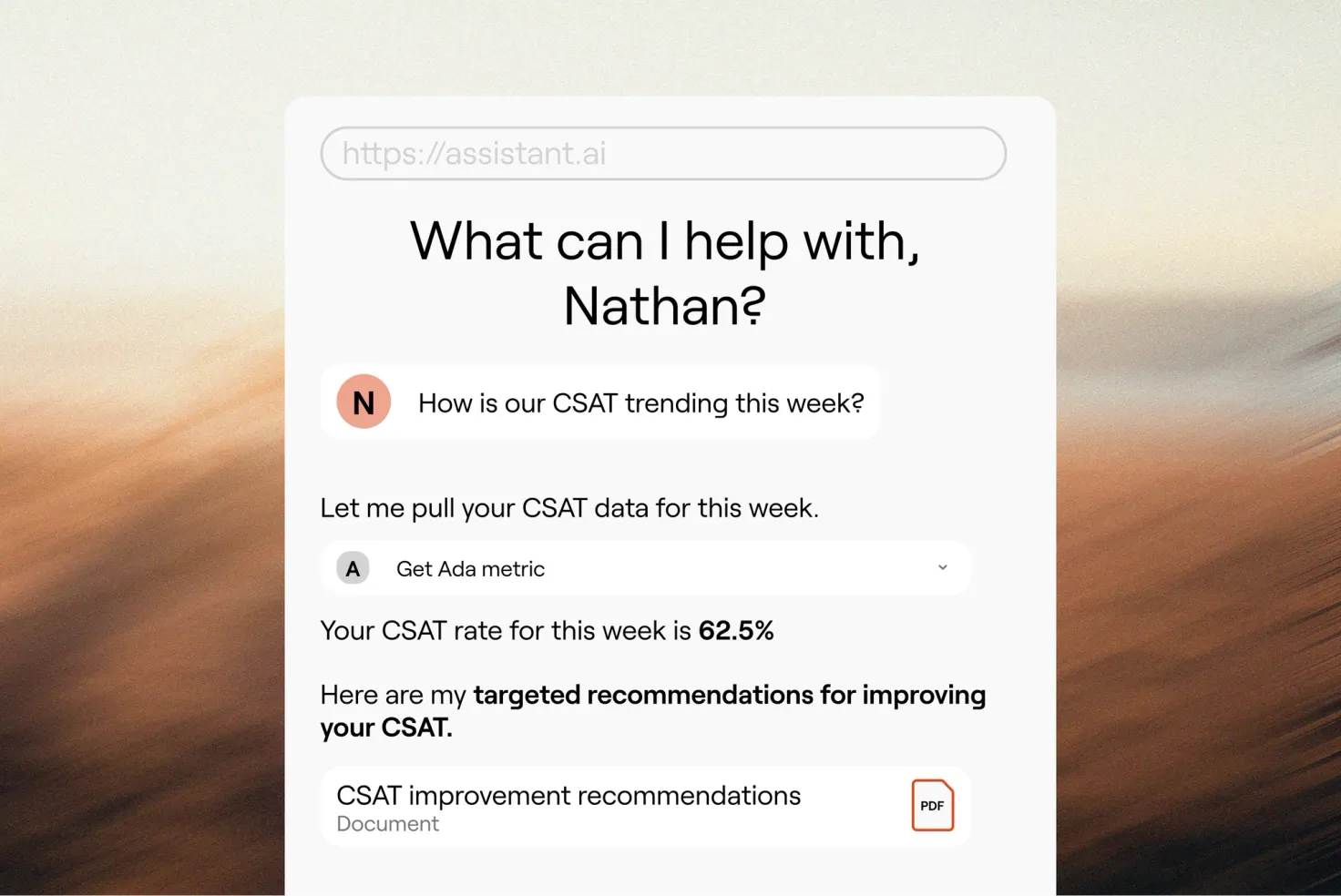
Conversational analytics answers the why. But the real value comes from what you do next, and until now, that meant leaving your AI workspace to make changes in the Ada dashboard, then coming back to check if they worked.
That gap is now closed.
With the latest updates to Ada's MCP Server, ACX managers can move from analysis to action to validation in a single conversation:
The result: a complete improvement cycle—analyze, act, test, measure—in one place, conversationally.
Your AI agent doesn’t just power conversations, it captures rich data in every interaction. Data that can surface insights and improvements across your customer experience.
But metrics alone don’t drive change. Insight does.
Conversational analytics bridges the gap between raw numbers and real understanding. With the ability to act on those insights—updating knowledge, running Simulations, and validating improvements—directly from your AI assistant, the gap between understanding and impact all but disappears. It gives authorized teams the ability to explore Ada data in natural language and share insights that drive meaningful action across the business.
Ada’s MCP Server makes this possible at scale. It brings your customer data into the tools your teams already trust, without adding friction or complexity. You get enterprise-grade control with consumer-grade simplicity.
This is what the future of AI-powered CX looks like: intuitive, transparent, and built to move your business forward.
Discover how Ada connects with tools like Claude and ChatGPT to power conversational analytics. Get the technical details on how MCP makes it possible to query your AI agent data in real time, securely and at scale.
Learn more