RFP template: Choosing AI technology for enterprise customer service
An Excel sheet containing 100+ detailed evaluation questions across seven categories in scoring-ready format you can send directly to vendors.
Learn More

There’s a familiar story about how different generations approach AI customer service. Younger customers are more open to it. Older customers are more skeptical. One group leans digital. The other prefers human support.
It’s a clean narrative. It’s also incomplete.
When Ada partnered with NewtonX to survey 2,000 consumers globally , the data pointed to something more useful: generations don’t fundamentally disagree on AI for customer experience. They disagree on what should happen when it falls short.
Gen Z and Baby Boomers ranked problem-solving ability and accuracy as their top priorities in customer service. Both ranked empathy last. That difference is easy to overlook. But it’s where many enterprise AI strategies start to break down.
A strategy built on the old generational script is likely failing multiple cohorts simultaneously. The misses aren't random. They're predictable—and fixable.
Across every generation, the same priorities rise to the top.
When consumers were asked to rank customer service attributes, accuracy and problem-solving ability ranked first for every generation. Empathy scored last by a wide margin.
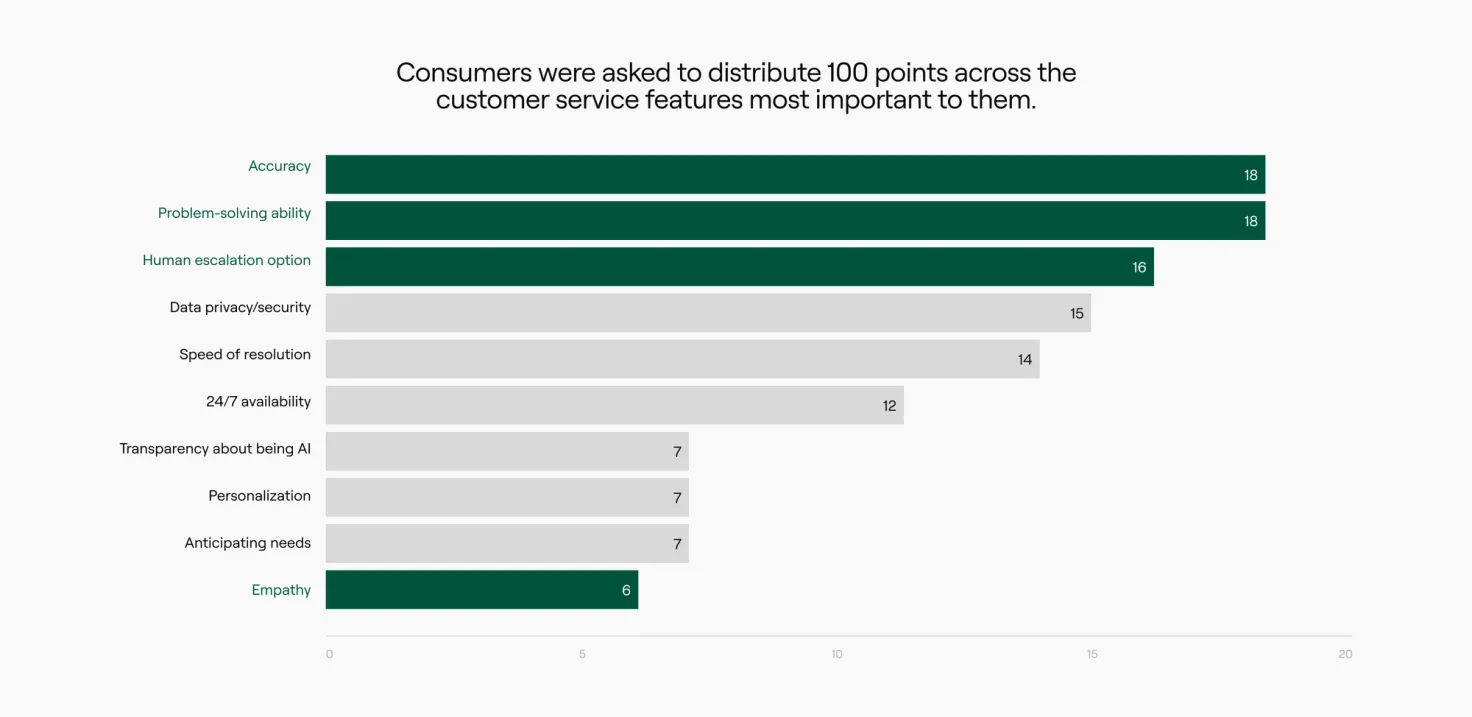
That ordering holds across age groups. That means customers, as a whole, aren’t evaluating AI on how “human” it sounds. They’re evaluating AI on whether it works.
When it comes to AI acceptance, the results are similar for simple and moderate-complexity tasks: between 86% and 94% across all age groups. Generations aren't diverging on whether AI should handle account updates, status checks, or service issues. They're largely aligned that it should.
That level of consistency matters. Improving AI's core capability—its accuracy, comprehension, and ability to actually resolve issues—is an investment that pays across generational lines. It's the foundation that earns trust everywhere.
The divergence appears when task complexity rises, and especially when AI fails.
If expectations are aligned, where does the divide come from? It appears when interactions become more complex or when something goes wrong.
The complexity tolerance gap is narrower than the conventional wisdom suggests, but it's real.
Across all consumers, preference for fully AI handling drops from 40% on simple tasks to 18% on complex ones, while preference for human handling rises from 13% to 29% over the same range. The generational data reveals who's driving that shift.
For complex tasks, Millennials show the highest AI acceptance at 41%, while Baby Boomers trail at 32%. For the highest stakes use cases, such as insurance eligibility, Gen Z is three times more likely than Baby Boomers to have already engaged an AI agent.
Gen Z and Millennials also index lower on most AI failure conditions, suggesting a higher tolerance for friction. Baby Boomers and Post-War consumers do not extend that latitude.
The most significant differences appear when AI doesn’t deliver.
Baby Boomers and Post-War consumers are the highest-risk cohorts when escalation paths are blocked or poorly designed. 25% of Baby Boomers and 32% of Post-War consumers reported having to find a human themselves after AI failed, compared to 17% of Gen Z and 20% of Millennials.
That's not a preference difference. That's businesses forcing older consumers to absorb friction that younger consumers are more willing to tolerate.
When asked what would cause them to stop using a company's AI service entirely, the gaps widen further.
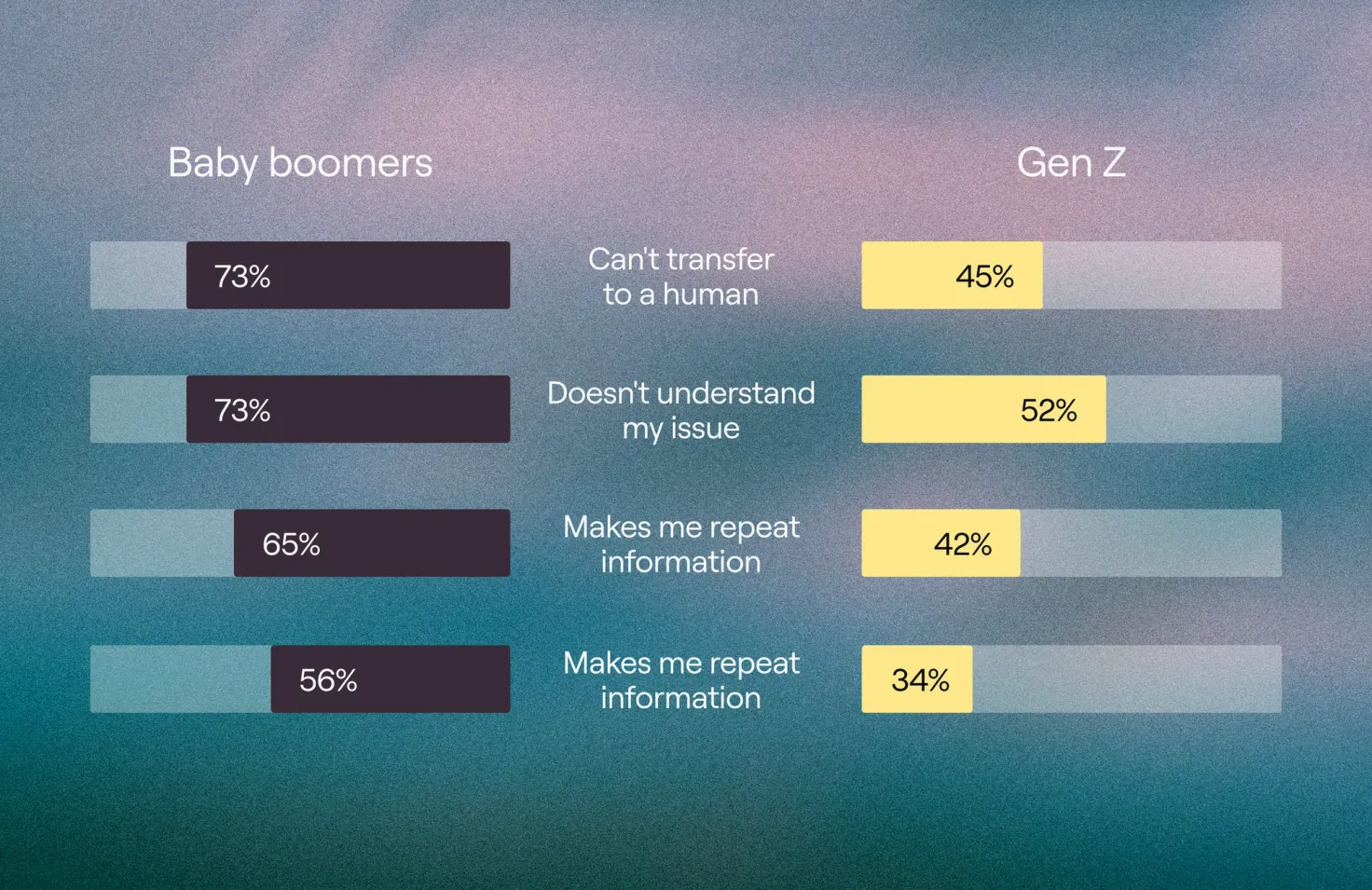
Across all generations, 57% of consumers say they would stop using a company’s AI customer service if they couldn’t reach a human when needed. That’s the single largest trust risk in the dataset.
Inside that number, Baby Boomers represent a meaningfully elevated churn risk. An escalation design that treats every consumer identically is quietly failing your oldest and, frequently, most loyal customers.
Disclosure follows a similar pattern: 74% of all consumers expect to be told they’re interacting with AI at the start of the conversation.
Expectations vary around timing:
This doesn't mean disclosure is optional for younger consumers. A clear majority across every generation expects it before or at the start of the interaction. But the threshold for frustration when disclosure is delayed skews meaningfully toward older cohorts.
Businesses that withhold disclosure entirely (10%) or delay it until handoff (13%) are concentrating risk precisely where tolerance is weakest.
It’s tempting to interpret these differences as a segmentation challenge. They’re not.
Most AI customer service strategies fail for a simpler reason: the system itself isn’t reliable enough to meet shared expectations.
When those issues appear, every customer notices. Different generations react differently, but the root cause is the same.
The practical takeaway here isn't to build four separate AI experiences. It's to build one AI core strong enough to earn trust everywhere, then configure how it's delivered for each cohort.
Agentic AI changes what’s possible in customer experience. AI customer service agents can now (and must):
We’re talking accurate, truly resolved AI for customer experience, with clean escalation paths and disclosure from the start. These are the universal requirements that determine whether any consumer stays or leaves.
That shift changes what success looks like. Organizations need a way to:
Without that, early success tends to plateau.
Getting there—building AI that performs reliably across cohorts—requires treating it as a system, not a set of deployments.
That's the premise of agentic customer experience (ACX) : an operating model connecting the technology, methodology, and expertise required to continuously improve AI performance over time.
Instead of isolated wins, ACX creates the infrastructure for consistent performance. That shift is what allows organizations to move from early success that plateaus to compounding improvement over time.
With that foundation in place, the configuration layer is where generational design earns its keep: which channels AI operates on, how escalation is framed and paced, and how disclosure is worded. These are the levers that translate a strong core into experiences that land across cohorts.
Baby Boomers need escalation pathways that are frictionless and obvious, not gated behind clarifying questions. Gen Z-dominant channels can absorb more AI friction, but they're not infinitely patient, and the capability bar still applies.
Most enterprise AI strategies treat generational variation as background noise—something to average out, not act on. That's a mistake.
The data maps exactly where trust is earned and where it breaks across your customer base.
These pressure points showing up in your CSAT scores and abandonment numbers right now. The businesses that treat this as signal—and builds the infrastructure to act on it—will have an advantage that compounds.
The ones that don't will keep building for the average consumer, which means building for no one in particular.
There’s a common assumption that consumers are skeptical of AI in customer service. The data says otherwise. Our 2026 report surveyed 2,000 consumers to understand how people actually experience AI in customer service today.
Read report