
RFP template: Choosing AI technology for enterprise customer service
An Excel sheet containing 100+ detailed evaluation questions across seven categories in scoring-ready format you can send directly to vendors.
Learn More

Online gaming has become one of the toughest proving grounds for AI customer experience.
Most AI customer experience programs are stress-tested on ecommerce returns, order tracking, or subscription billing. Gaming is different. Operators have to navigate jurisdiction-specific compliance requirements, emotionally charged financial conversations, VIP player expectations, and unpredictable spikes in contact volume—all while delivering fast, accurate experiences across multiple brands and markets.
It's the kind of complexity that exposes the limits of scripted automation. Green Feather Online saw it as an opportunity.
The Malta-based gaming operator runs four online casino brands across multiple markets, supporting 20+ languages, and handling roughly 125,000 customer inquiries every month. In just five months, its Ada-powered AI agent increased automated resolution from 3% to more than 40% while maintaining a 90% CSAT rating for one of its most complex workflows.
For organizations wondering whether AI can handle their most complex customer interactions, Green Feather offers a compelling answer.
The Malta-headquartered gaming operator grew automated resolution by 37 percentage points in five months by fully committing to AI CX operations.
Read story
Most enterprises manage one or two sources of customer experience complexity. Gaming combines several at once.
Every interaction sits at the intersection of regulation, financial services, entertainment, and customer trust. That creates operational challenges that many AI programs never have to confront.
Consider what lands in a support queue on a busy Friday night. Thousands of players may be contacting support simultaneously, each with different expectations, account histories, and regulatory requirements. Some are asking about interrupted rounds or bonus eligibility. Others are reporting balance discrepancies or requesting goodwill gestures. Players expect immediate, personalized service, while every response must comply with market-specific regulations.
The challenge isn't simply answering questions quickly. It's making the right decision every time. Gaming pushes AI across four dimensions at once:
If AI can consistently resolve conversations in an environment defined by compliance, financial complexity, and unpredictable demand, it's well positioned to succeed almost anywhere.
Green Feather didn't introduce AI as another support tool or automation layer. They rebuilt their customer experience operation around it. That shift changed how the team thought about ownership.
Anton Vavercak's role evolved until agentic customer experience (ACX) became his primary focus. Rather than treating AI as a side project, he became responsible for continuously improving it—refining the knowledge base, coaching the AI agent, building Playbooks, and analyzing performance to identify the next opportunity for optimization.
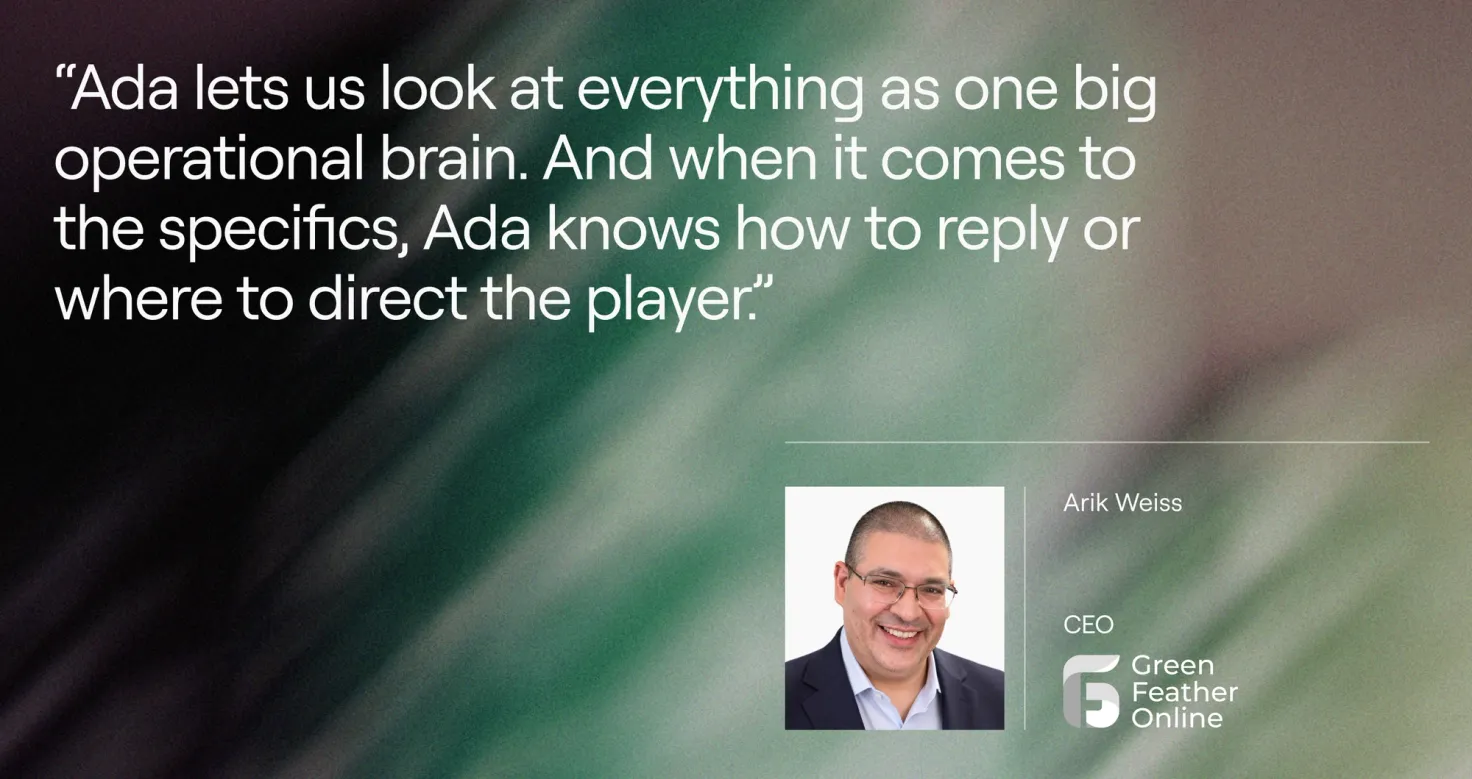
Arik compares the approach to onboarding a new employee: "Think of the AI agent as a very capable but untrained human agent. Just like you would with any new hire, you make sure they have proper onboarding, access to knowledge, consistent coaching, and performance evaluation. That's how we treat Ada."
That philosophy became the foundation of Green Feather's ACX program.
Their progress—from 3% to more than 40% automated resolution in five months—didn't come from a single integration or Playbook. It came from continuously improving three core capabilities:
Here’s what those disciplines look like in practice.
Agentic customer experience in online gaming means a single AI agent that can handle first contact across multiple brands and markets, execute complex multi-step workflows, pull live player data through APIs, and resolve sensitive financial interactions—all without human intervention.
Rather than building separate programs for each brand or market, Green Feather runs an agentic customer experience operation across all four brands through a shared foundation—one that balances consistency with regional nuance.
That architecture works in two ways:
Handling compliance in AI customer experience comes down to precision at the knowledge level. By scoping articles to specific player groups and entry URLs, and encoding regional rules directly into Playbooks, the AI agent applies the right logic for each market automatically—without relying on agents to manually navigate jurisdictional differences.
The result is one operation that scales across multiple markets without duplicating customer experience teams or maintaining separate workflows for every market.
Green Feather focused its efforts on workflows that span both high-stakes support and proactive player engagement—not because they're easy to automate, but because solving them would push AI customer experience beyond the limits of conventional customer service automation.
Three Playbooks illustrate that approach particularly well.
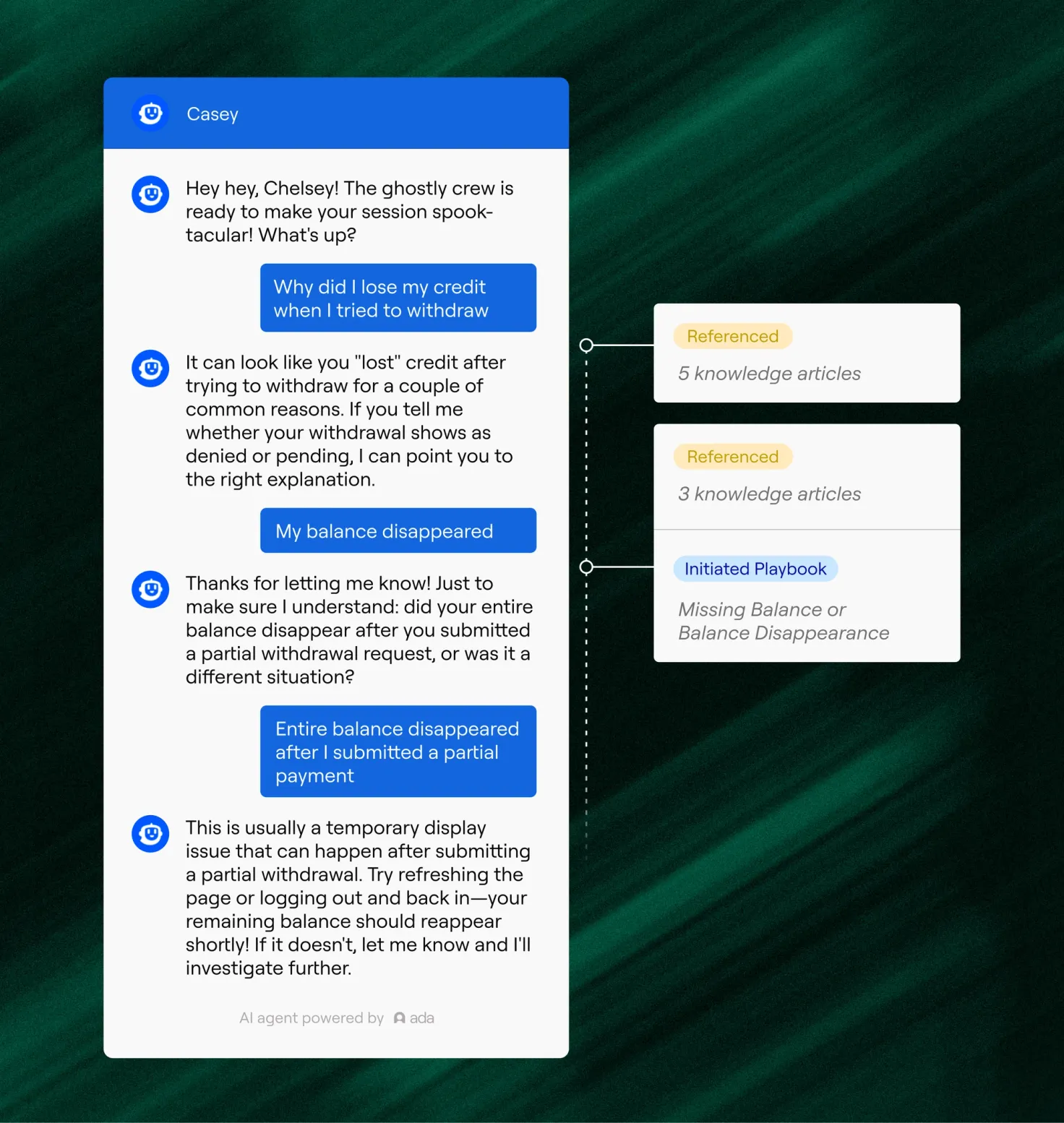
Few customer conversations are more emotionally charged than a missing balance. When players believe money has disappeared from their account, the AI agent has to do more than provide reassurance. It has to identify what happened.
Anton Vavercak, Green Feather's Solution Engineer, rebuilt the investigation process inside Ada. The Playbook retrieves account information, evaluates the possible scenarios, applies the appropriate business logic, and either resolves the issue or escalates it to a human agent when necessary.
"Balance discrepancies are sensitive," Anton explains. "There are only a few possible explanations, and Ada works through them based on the player's responses. It took a couple of rounds of coaching to get right, but it now saves the team significant effort."
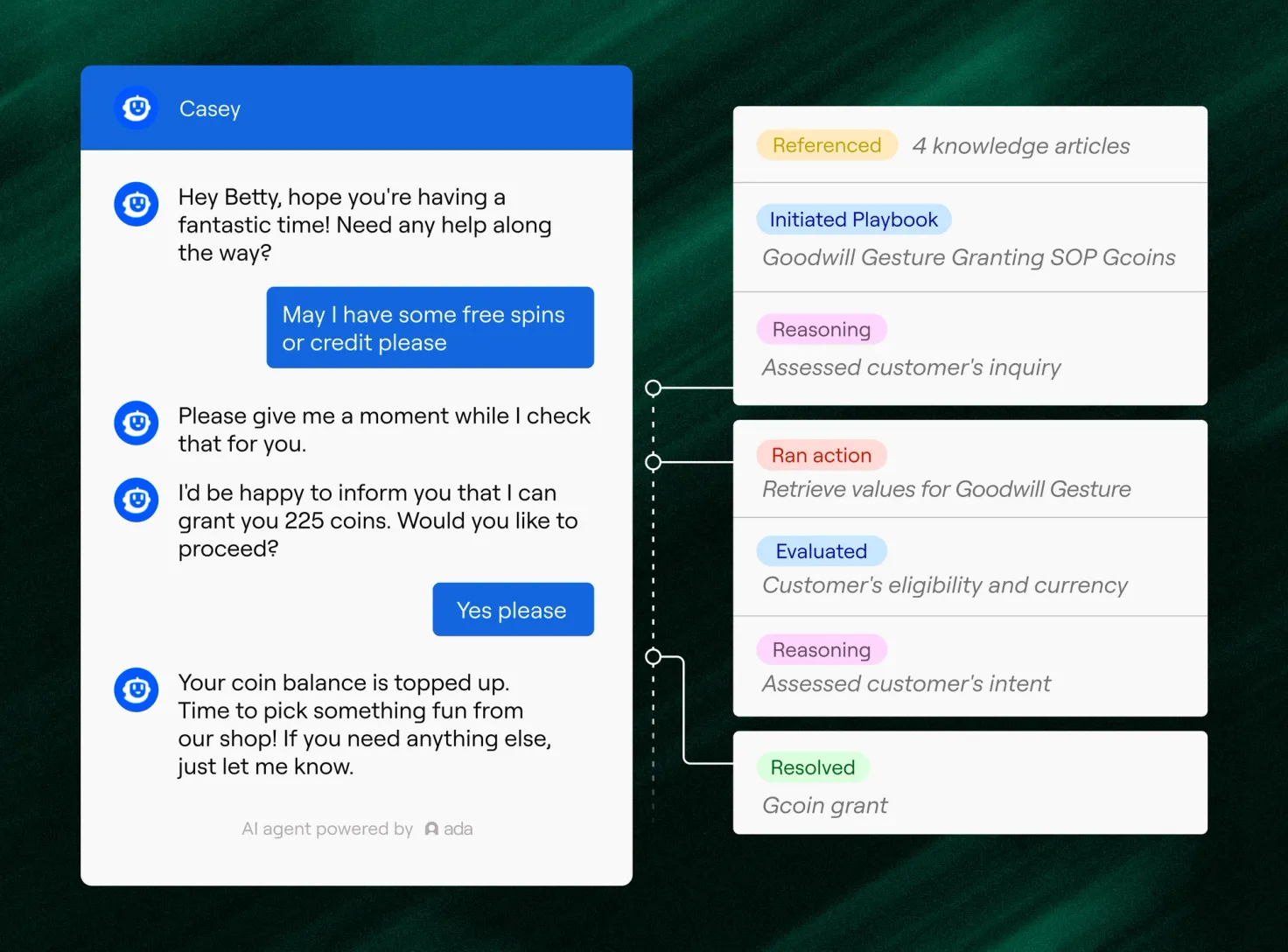
Goodwill gestures present a different kind of challenge. When players request complimentary credits or bonuses, agents must weigh multiple factors before making a decision. Eligibility checks often require reviewing several systems, turning what seems like a straightforward request into a manual, time-consuming process.
Green Feather rebuilt that workflow inside a single Playbook. The AI agent now:
What previously took several minutes of manual work now happens during a single conversation, creating a faster experience for players while giving human agents more time to focus on exceptions rather than routine evaluations.
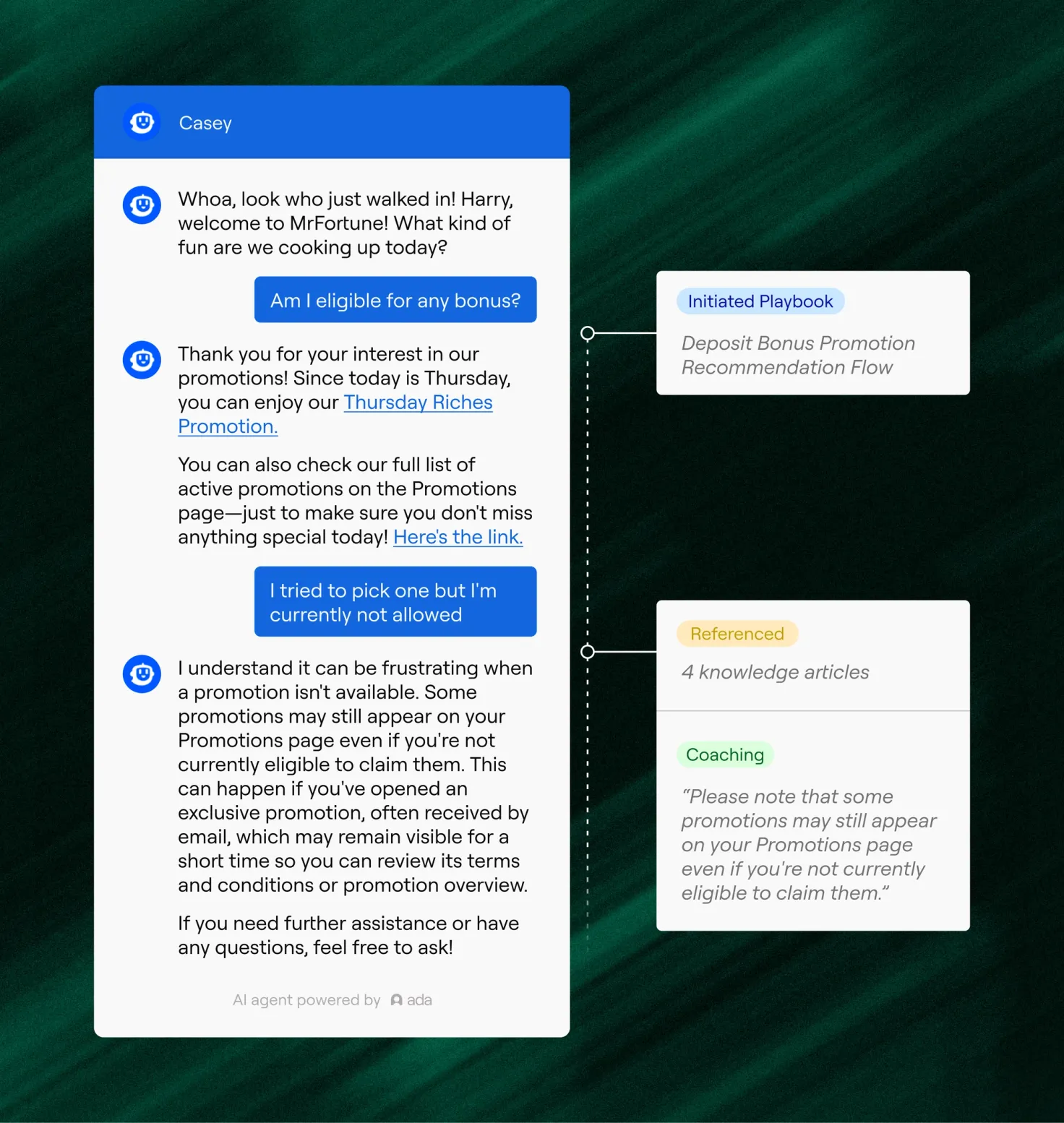
Green Feather has also extended Playbooks beyond support workflows. Its Deposit Bonus Recommendation Playbook personalizes promotional offers based on the player's profile, activity, and timezone. New players receive the appropriate welcome offer, while returning players receive promotions that align with their eligibility and preferences.
Rather than directing customers to generic promotions, the AI agent recommends the most relevant offer within the conversation itself.
Taken together, these workflows demonstrate what's possible when AI moves beyond answering questions and begins executing the operational processes behind great customer experiences.
One of Green Feather's biggest discoveries came after these Playbooks were already live.
Using Ada's Performance Center, the team began analyzing automated resolution by intent, identifying where conversations stalled, and tracking patterns across thousands of customer interactions.
Those insights changed the questions they were asking.
Instead of asking how they could respond to inquiries more effectively, they started asking why those inquiries existed in the first place. Open-round inquiries became one of the clearest examples.
When players encountered technical issues during gameplay, they contacted support to resolve unfinished rounds. Performance Center revealed just how frequently those conversations were occurring, prompting Green Feather to improve both the support experience and the underlying product experience.
The team took two actions:
Today, open-round inquiries achieve a CSAT of around 90%.
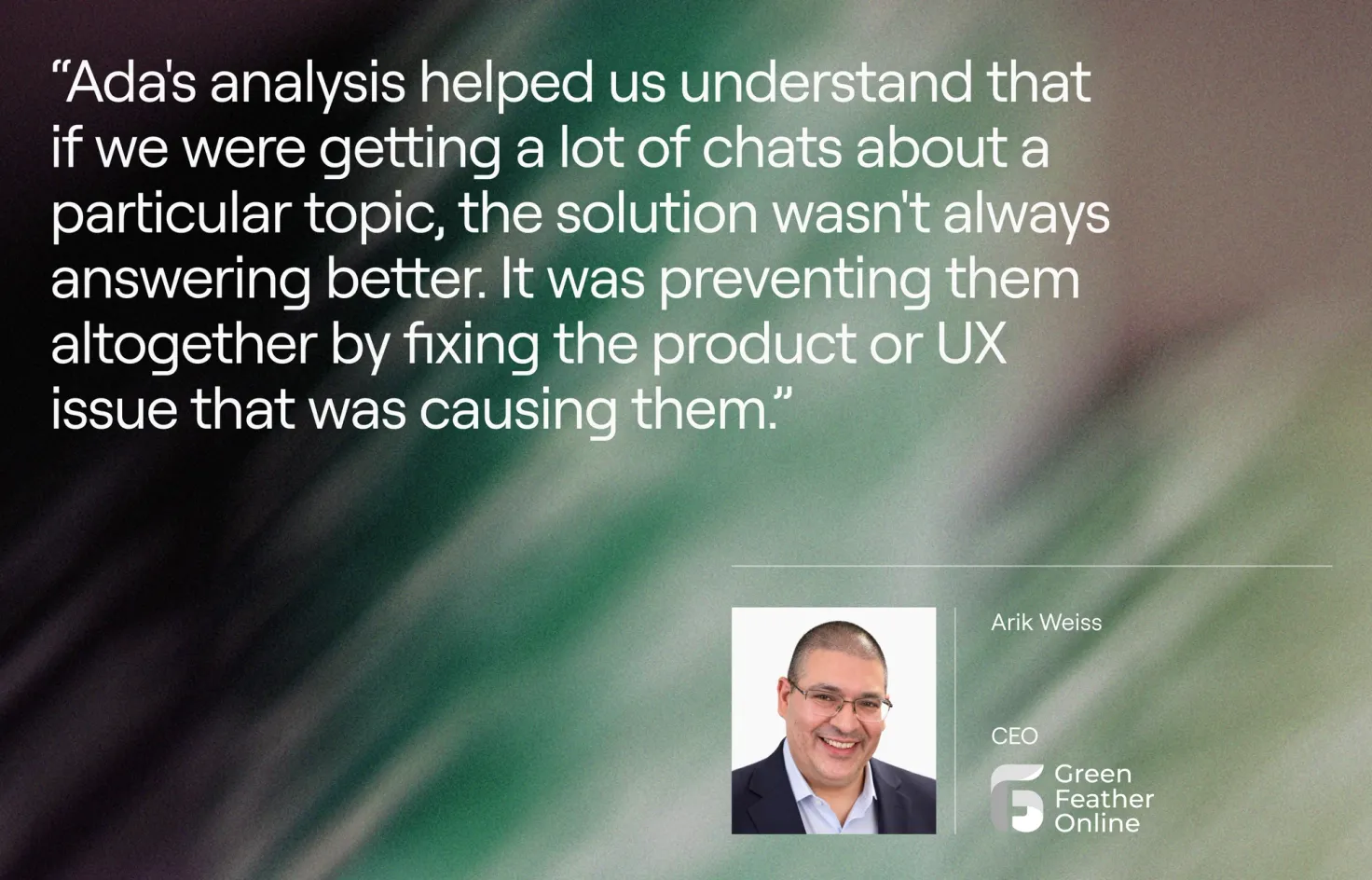
That's an important shift. As AI agents handle more customer conversations, they don't just reduce workload. They surface operational patterns that help organizations improve products, processes, and customer experiences before customers ever need to reach out.
Green Feather's results didn't come from finding the right tool. They came from treating AI as an operational capability that required a dedicated owner, continuous improvement, and the discipline to keep building.
"What it actually requires is someone fully dedicated to owning the ACX program—iterating daily, testing, failing, improving," says Arik. "Not managing it as a side project or a backlog item for the tech team."
That investment has changed how Green Feather grows. As customer volume increases, the company no longer has to scale headcount at the same rate. AI agents handle recurring operational work, allowing human agents to focus on the conversations that benefit most from empathy, judgment, and relationship building.
Gaming may be one of the world's most complex customer experience environments for agentic AI in customer service, but Green Feather's story isn't just about gaming. It's about what happens when an organization commits to building AI into the way customer experience operates.
The complexity hasn't gone away. Green Feather still supports four brands across multiple markets, navigates evolving regulations, and manages unpredictable spikes in demand. What changed is the team's ability to operate confidently through it.
As Arik puts it: "We're not afraid of peaks anymore."
Before choosing the right AI customer service solution for enterprise scale, use this assessment to make sure your organization is set up for long-term success.
Take assessment 