RFP template: Choosing AI technology for enterprise customer service
An Excel sheet containing 100+ detailed evaluation questions across seven categories in scoring-ready format you can send directly to vendors.
Learn More

Health insurance isn’t just complex, it’s personal.
Members aren’t calling with generic questions. They’re reaching out with billing issues, coverage confusion, and high-stakes concerns that demand clarity.
That’s why customer experience matters. And it’s why more and more health insurers are turning to conversational AI in insurance —not to deflect, but to deliver faster, clearer resolutions with care.
This post is part of our AI agent in the field series: a look at how real AI agents are supporting real customer service teams. In this edition, we’re spotlighting 5 use cases for AI in insurance that health insurers are automating right now.
Each one targets a high-friction member need and helps insurers address long-standing CX challenges like navigating complex coverage, handling open enrollment surges, resolving billing, and boosting engagement in preventative care.
These aren’t pilots. They’re production-ready use cases for AI in health insurance—already live, already delivering results, and already changing how members experience their plans.
In health insurance, the most common conversations are often the most critical. These are the moments when a delayed answer can mean missed care, a denied claim, or a member dropping off entirely.
Think of the member trying to find an in-network doctor, understand why a claim was denied, or add a newborn to their plan. These aren’t low-value interactions. They’re high-stakes, high-volume touchpoints that shape the entire member experience.
But for many health insurers, these moments still rely on disjointed systems, overloaded teams, and service models that can’t keep up.
With the right AI customer service platform , these moments become scalable, consistent, and safe to automate. AI agents can follow plan logic, connect to internal systems, and deliver clear answers without delay.
That’s why these 5 use cases for AI in insurance aren’t just good candidates for automation, they’re the first ones you should automate.
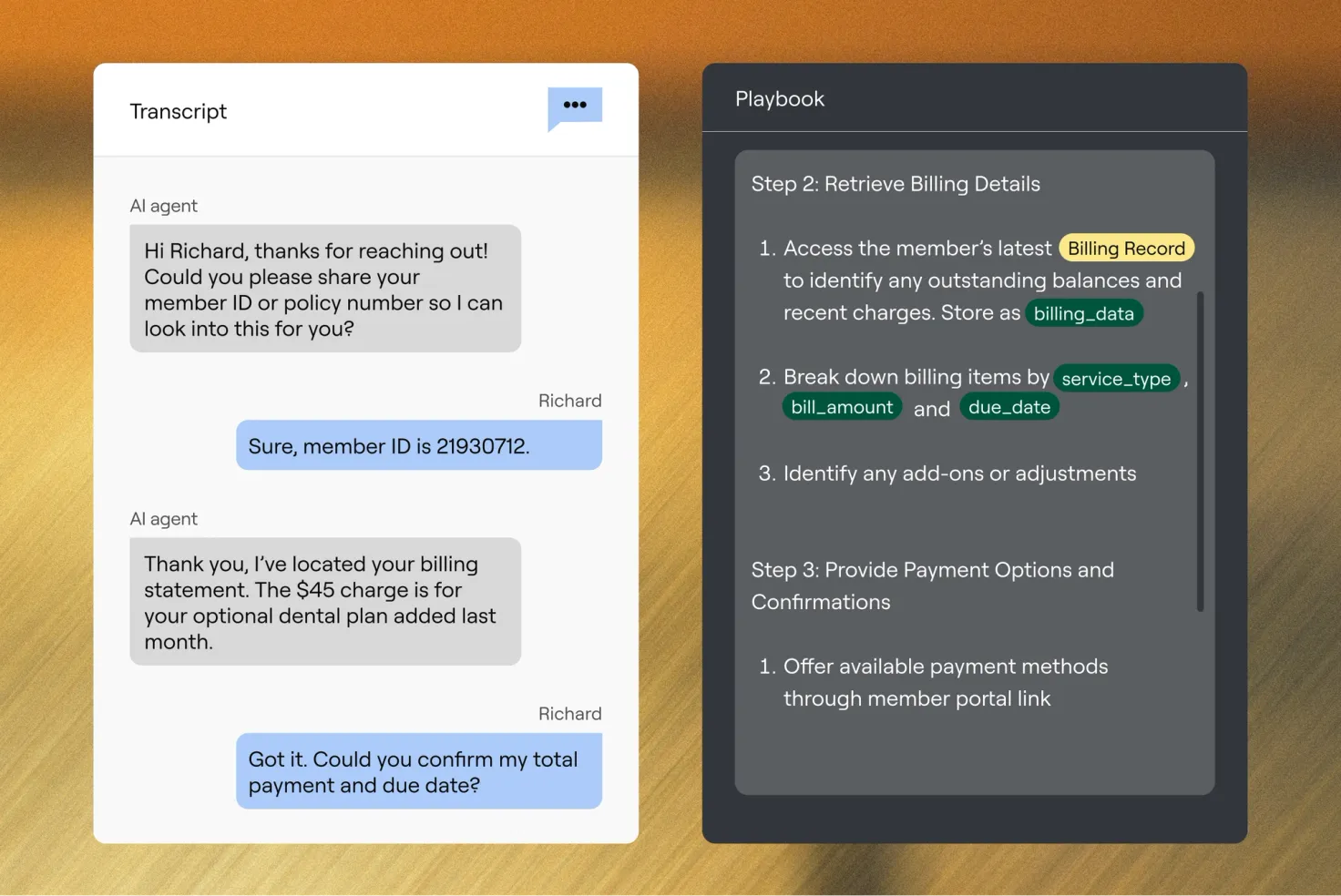
Billing is one of the most common reasons members reach out—and one of the most emotionally sensitive. A confusing bill or an unpaid premium can create stress fast, especially when healthcare and financial uncertainty collide.
Payment questions are constant. Members want to resolve bills quickly, without navigating a portal or waiting on hold to ask, “Can I just pay my health insurance premium online?”
They’re looking for clarity and control, not another transfer.
With the right AI for health insurers, billing stops being a bottleneck. These once-manual conversations can now resolve themselves. AI agents can:
This isn’t just automation for automation’s sake. It’s faster answers, fewer backlogs, and a smoother experience during one of the highest-friction parts of the member journey.
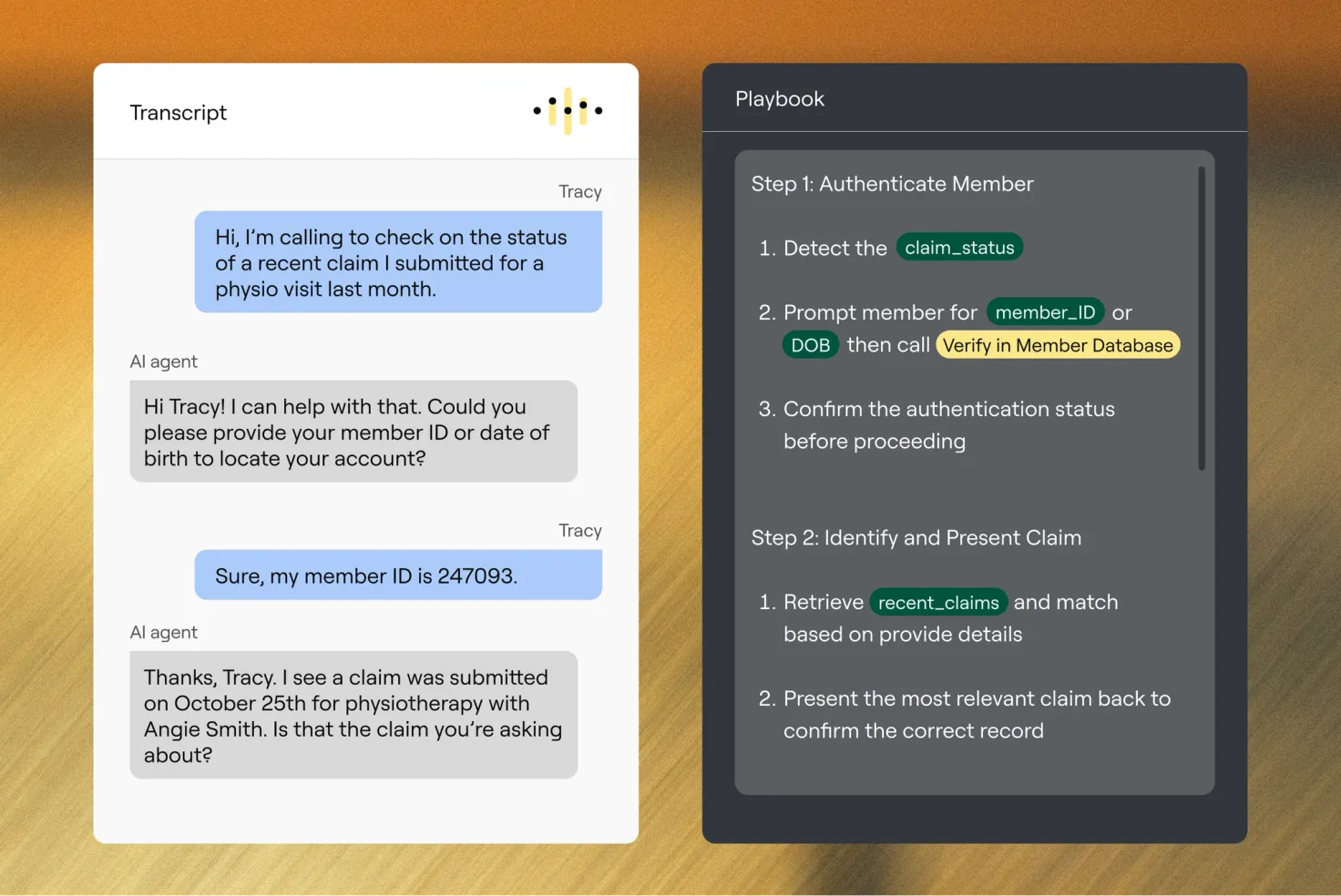
Claims are emotionally loaded and often unclear, especially when members are waiting for answers. Whether it’s a denial, a delay, or just a missing update, they’re often looking for clarity on what’s been processed, what’s still pending, and what’s holding things up.
Members frequently ask, “How do I check the status of my health insurance claim?” when they're waiting on critical care or reimbursement. With AI for health insurers, they don’t have to wait. They get clarity in the moment.
AI agents can:
These conversations drive up volume and drag down resolution time, not because they’re complex, but because the information lives across disconnected systems. This is one of the most impactful use cases for AI in health insurance, and a critical step toward delivering better service during high-stress moments.
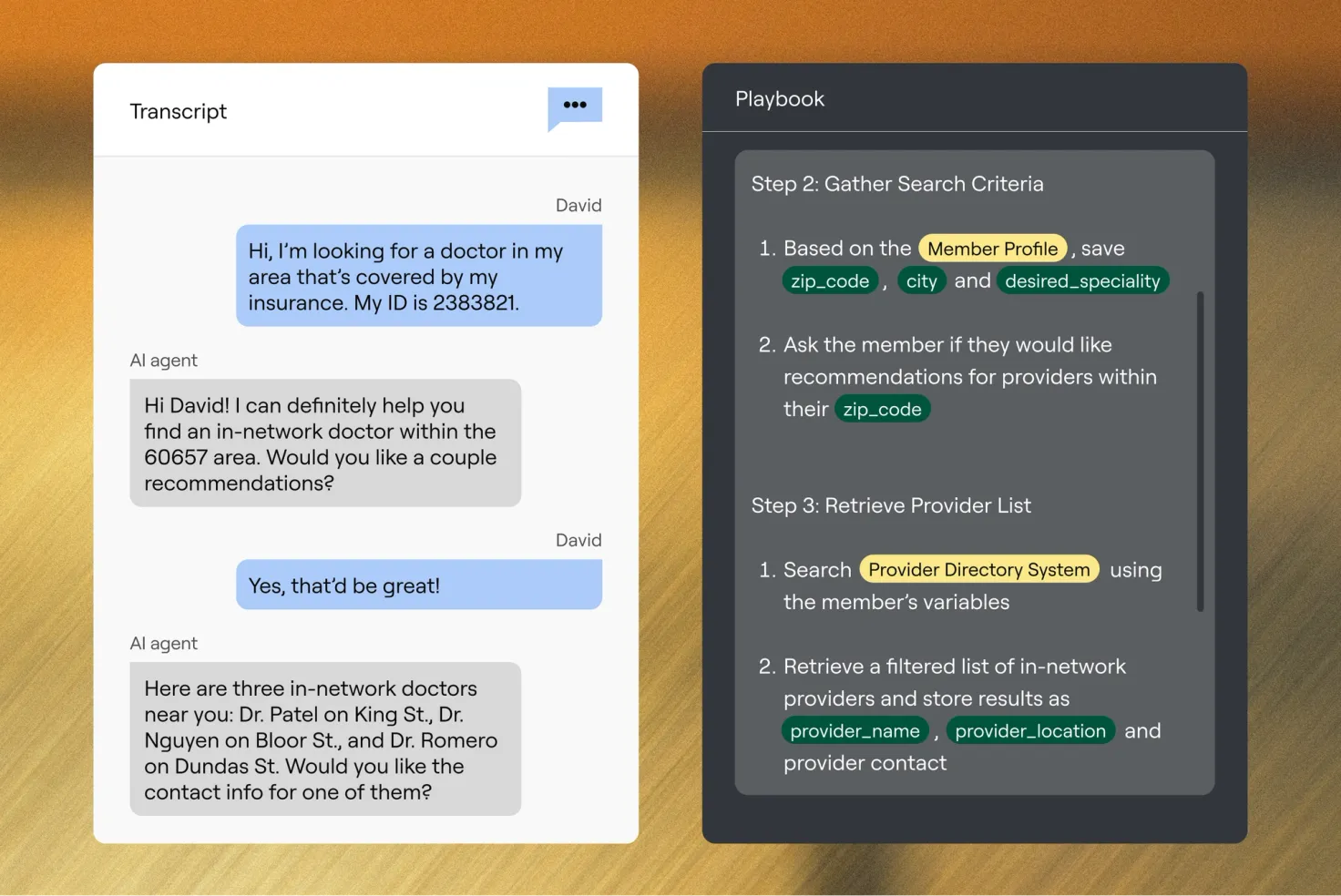
Finding in-network providers should be easy, but it rarely is. Members want someone close, available, and aligned with their preferences. Too often, they’re left guessing.
Search tools are clunky. Directories are outdated. And when members hit a wall, the call center takes the hit. Questions like “Is my doctor in network with my insurance plan?” are everyday requests. But when directories are outdated or confusing, they lead to escalations.
With an AI in health insurance, finding a doctor becomes a real conversation—fast, guided, and stress-free. AI agents can:
This is one of the best examples of AI for health insurers delivering immediate value to both members and operations teams.
Policy inquiries are the heartbeat of health insurance customer service, and they’re also some of the hardest to get right. From coverage gaps to copay confusion, these questions are constant, complex, and deeply personal
Members often ask, “What is my deductible and copay?” and they’re expecting a clear, personalized answer, not a jargon-heavy plan summary.
That’s where an AI in health insurance can make all the difference. AI agents can:
This is where an AI customer service platform really shines: making complicated answers simple and scalable.

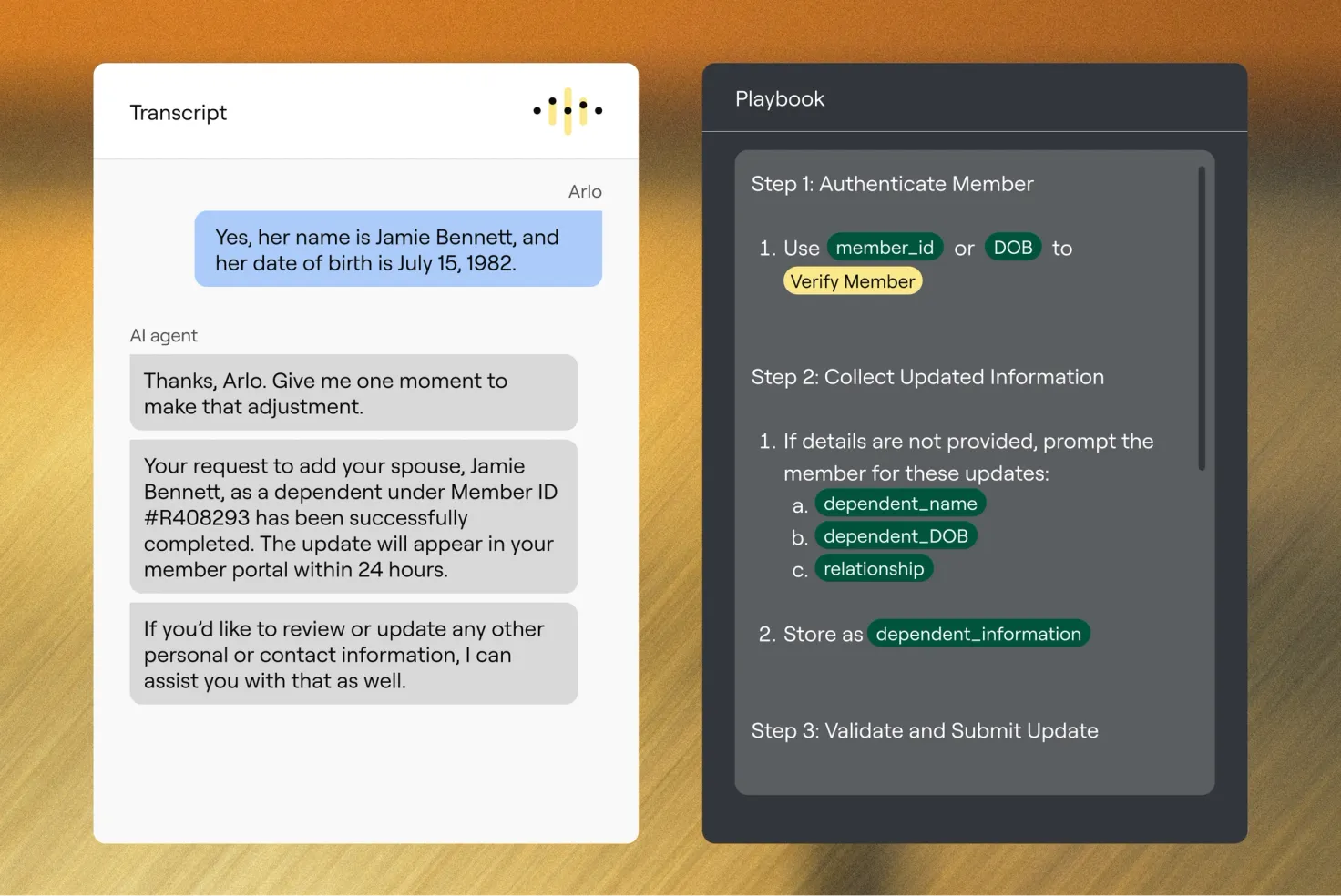
Updating personal or dependent information sounds simple, but it’s one of the most operationally risky and time-sensitive service flows in health insurance.
Members don’t want to dig through a portal to find out, “How do I add a dependent to my health insurance?” They just want to make the change and move on.
With the right AI agent, these updates are quick, guided, and error-free. AI agents can:
It’s a small interaction that has a big downstream impact, and it’s one of the easiest ways to free up your human agent's time.
Every use case in this post isn’t just plausible—it’s already happening. Health insurers are automating these interactions today, with AI agents trained to resolve them safely, consistently, and at scale.
Ada’s Playbooks give you a roadmap for doing the same. Each one maps to a specific health insurance workflow and includes step-by-step guidance on how an AI agent should handle it: how to respond, when to escalate, what systems to connect to, and what good looks like.
Whether you’re just getting started or scaling an AI-first service strategy, Playbooks help you move fast, launch safely, and show measurable impact from day one.
It’s a smarter way to operationalize AI in health insurance, and a proven path to better service, fewer tickets, and stronger member relationships.
Browse real examples of AI agents using plain-language instructions to automate multi-step processes with speed and precision.
Explore Playbooks Library