
RFP template: Choosing AI technology for enterprise customer service
An Excel sheet containing 100+ detailed evaluation questions across seven categories in scoring-ready format you can send directly to vendors.
Learn More

For years, omnichannel customer experience meant expanding coverage. Add email. Add messaging. Add voice. Connect them together and support customers wherever they show up.
That model worked when channels were simply communication surfaces.
But once AI began powering those interactions, each channel stopped being just a touchpoint. It became a place where decisions were made.
As AI expands across channels, managing it becomes harder—not because the technology isn’t capable. In many cases, the AI powering each channel is remarkably advanced.
The challenge is structural. And voice is where that strain becomes most visible.
AI voice agents don’t just respond . They reason in real time. They authenticate customers, manage interruptions, retrieve data, execute multi-step workflows, and confirm outcomes all within one continuous interaction.
There’s no buffer. No asynchronous delay to hide inconsistent logic. Every decision happens immediately.
Voice doesn’t create architectural weakness. It exposes it.
If AI voice agents for customer service are going to lead the enterprise customer experience, they require a different foundation, one unified way to manage how AI agents think, act, and improve.
Before choosing the right AI customer service solution, it’s important to understand where your organization is at now. This assessment helps you answer that question with clarity and chart the right course forward.
Take assessment
AI voice agents are intelligent systems that autonomously manage live customer conversations over the phone. Unlike traditional IVR or scripted bots, modern AI voice agents:
But here’s the critical distinction: not all AI voice agents for customer service share the same intelligence layer as other channels.
In many enterprises, voice is layered onto existing chat-first or messaging-first systems. Each channel runs on its own reasoning framework. Business rules are duplicated. Definitions of “resolved” vary.
Those chat-first systems weren’t designed for the real-time demands and complexity of voice. When voice is retrofitted onto architecture built for asynchronous channels, latency increases, reasoning breaks under pressure, and the experience falls short of customer expectations.
Customers experience one journey. Intelligence behaves as many separate decision paths. What appears unified in reporting, fractures in real interactions.
That’s not true omnichannel customer experience. The future of omnichannel isn’t about integrating more touchpoints. It’s about managing intelligence as one.
Explore what capabilities AI customer service platforms need to deliver the omnichannel experiences that your customers crave.
Learn more Most enterprises introduced AI incrementally. A chat agent here. Email next. Voice layered in later. Each with its own workflows, safeguards, and performance metrics.
That approach delivered early value. But as customer expectations rose, interaction volumes increased, and enterprises were asked to do more with constrained resources, the channel-by-channel structure began to strain.
When AI logic lives separately across channels:
A chat may be marked resolved even if the customer calls minutes later. A voice interaction may succeed on its own metrics while contradicting a follow-up email. Each channel measures performance independently. But customers don’t think in channels. They interact with one brand, expecting one consistent experience.
This is the hidden cost of channel-first AI. And voice exposes it first.
Messaging and email are asynchronous. Voice isn’t. When customers call, every decision happens in real time. There’s no pause button. No second session to reconcile inconsistencies.
AI voice agents must combine two capabilities simultaneously:
In simple terms: talk quickly and think deeply at the same time.
When a request is straightforward—checking order status or confirming store hours—the agent responds instantly. When complexity increases—validating coverage, updating account details, applying credits, executing a multi-step refund—the AI agent must reason across policies and data without breaking the flow of conversation.
Without that balance, automation either feels scripted and brittle or collapses under pressure.
Voice doesn’t tolerate either.
The true test of AI customer service isn’t FAQ automation. It’s complex resolution. Consider a service disruption. In one interaction, an AI agent may:
Each step touches different systems, policies, and data sources.
In fragmented architectures, context can reset between intents. Decisions may be handled by separate systems. Resolution may be inferred because the session ended, not because the issue was fully addressed.
That’s how inflated resolution metrics happen.
With unified reasoning, the entire interaction is processed as one continuous flow. Context persists. Policies apply consistently. Resolution is confirmed explicitly.
As AI voice agents take on higher-stakes use cases, this distinction becomes critical.
Voice doesn’t create instability. It reveals whether the architecture was built to truly resolve, not just respond.
If an AI agent is becoming your most scalable customer-facing employee, it requires management.
The Agentic Customer Experience (ACX) Operating Model does exactly that. It recognizes that AI agents are not static deployments, they require structured workflows, governance, and continuous refinement.
ACX teams:
But ACX only works at scale when intelligence is unified:
Without that foundation, complexity multiplies as channels multiply. With it, complexity becomes easily manageable.
This is the architectural shift behind Ada’s new unified Reasoning Engine™ . Instead of layering AI logic independently onto each channel, the unified Reasoning Engine™ powers one AI agent across voice, messaging, and email from a single shared intelligence layer.
That means:
Because it is voice-first by design, it supports the most demanding channel from the start. If the architecture can handle real-time, multi-step voice interactions with speed, accuracy, and consistent quality, every other channel follows naturally.
At its core, the unified Reasoning Engine™ introduces:
Manage in one place. Engage everywhere.
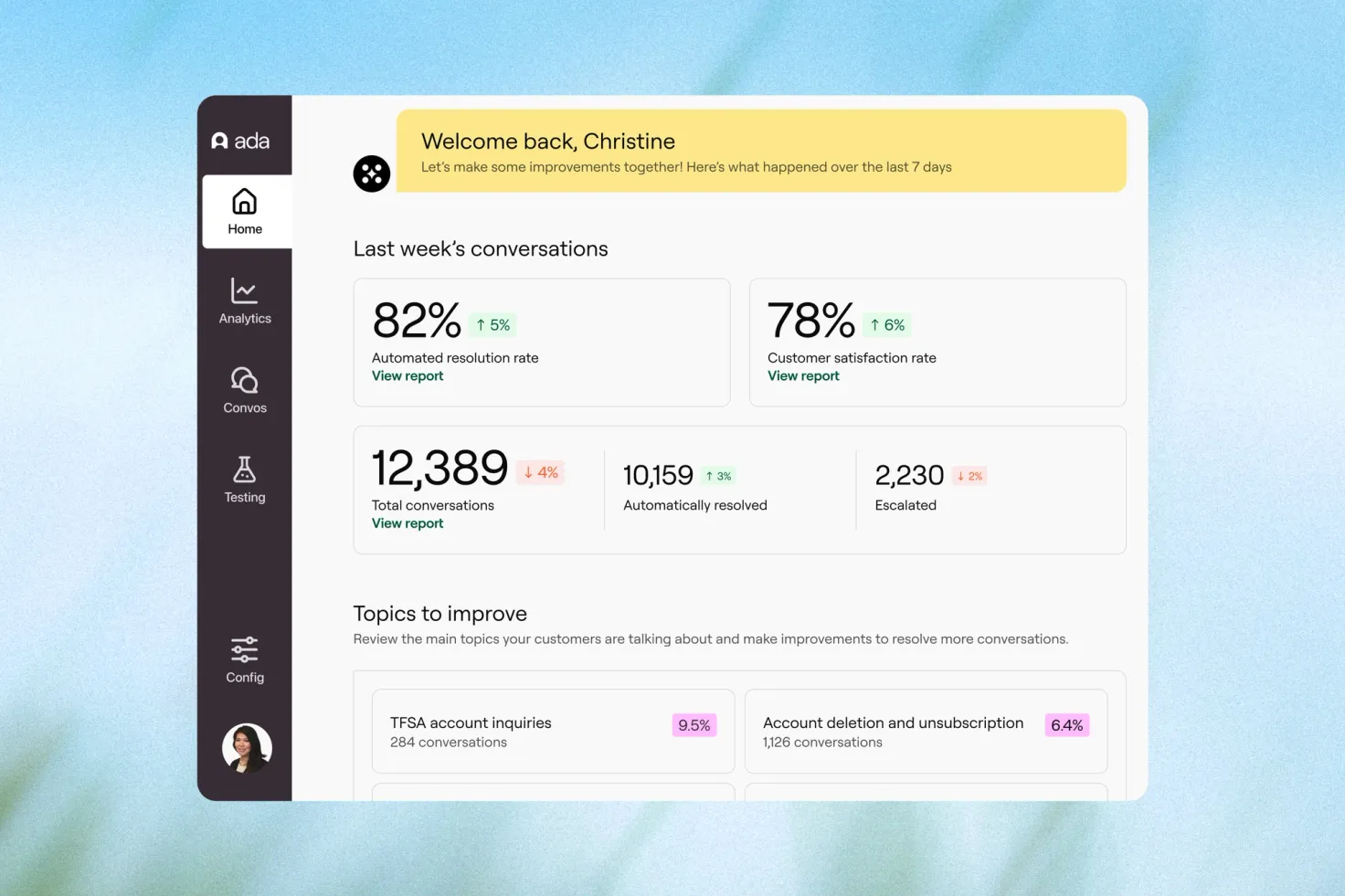
Architecture only matters if it changes how AI is operated. When intelligence is fragmented, ACX teams must:
Improving AI becomes a coordination exercise. Unified reasoning compresses that loop. Because the AI agent operates from one shared foundation:
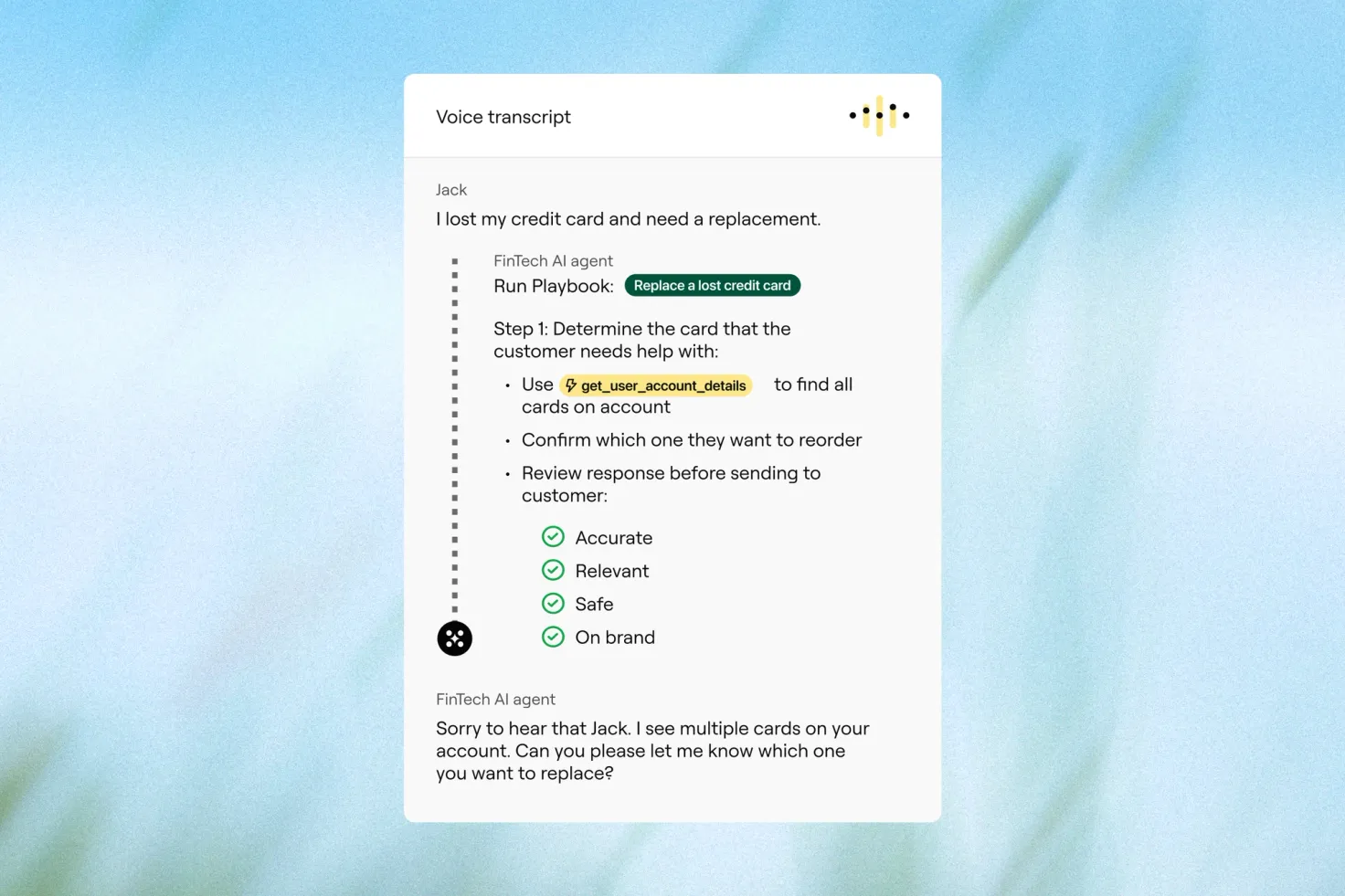
Instead of managing channels, ACX teams manage intelligence. The feedback loop shortens from weeks to minutes. AI customer service becomes a continuous discipline, not a periodic overhaul.
And that changes the economics of automation: lower cost-to-serve, higher CSAT, greater lifetime value.
“Voice has always been the hardest channel to transform,” said Brian Gilman, VP of Customer Support at workforce payments platform, Branch . “With Ada’s unified Reasoning Engine, that’s changed. Our AI agents can now reason through complex, high-stakes voice conversations with the same intelligence that powers our digital channels. That means faster, more accurate support when our users need it most, especially in moments that directly impact their pay. By elevating the voice experience, we’re reducing friction, resolving issues more efficiently, and ensuring workers get the clarity and confidence they deserve.”
Customers don’t think in channels. They think in problems they want solved.
Voice exposed what omnichannel customer experience strategies quietly tolerated for years: fragmented intelligence cannot deliver consistent customer experiences at scale.
AI voice agents raise the standard.
Ada’s unified Reasoning Engine™ replaces stitched-together systems with one, centralized intelligence layer that understands, decides, and acts consistently across every channel.
When AI voice agents can resolve complex issues with speed, accuracy, and governance built in, omnichannel customer experience stops being a coordination challenge. It becomes part of the architecture itself.
The future of AI customer service won’t be defined by how many channels you support. It will be defined by how many systems you no longer have to manage.
Ada launches the first unified Reasoning Engine, powering AI agents with centralized intelligence across every channel.
Learn more 


