
RFP template: Choosing AI technology for enterprise customer service
An Excel sheet containing 100+ detailed evaluation questions across seven categories in scoring-ready format you can send directly to vendors.
Learn More

If you work in insurance customer experience, you already know the line: “Your call is important to us.” And you know that, for most policyholders, it no longer rings true.
Hold times are growing. Agent workloads are unsustainable. And the pressure to deliver faster, more personalized service without ballooning costs is mounting.
That’s why leading insurers are turning to AI voice agents to transform their customer experience. The best AI voice agents for insurance don’t just answer calls, they resolve complex requests autonomously, personalize interactions in real time, and reduce cost-to-serve across high-volume channels.
In this guide, we’ll unpack what AI voice agents for insurance really are (hint: they’re not glorified chatbots), where they deliver the most value, what to look for in a platform, and how to deploy and scale voice CX with confidence.
Whether you’re managing rising call volumes or modernizing legacy systems, this is your roadmap to delivering faster, smarter, and more scalable customer service.
AI voice agents are intelligent systems that communicate with customers through natural, spoken conversation. They use advanced natural language understanding to interpret what a caller is saying, retrieve relevant policy or claim information, and resolve requests autonomously and at scale.
This makes them especially valuable in industries like insurance, where inquiries are often high-stakes and highly specific. A policyholder calling about a denied claim or billing issue doesn’t want to navigate a phone tree. They want a clear answer, fast.
When powered by platforms built for complex customer service environments, the best AI voice agents for insurance go beyond basic call routing. They act as a reliable extension of your team, with the ability to personalize responses, automate workflows, and continuously improve performance.
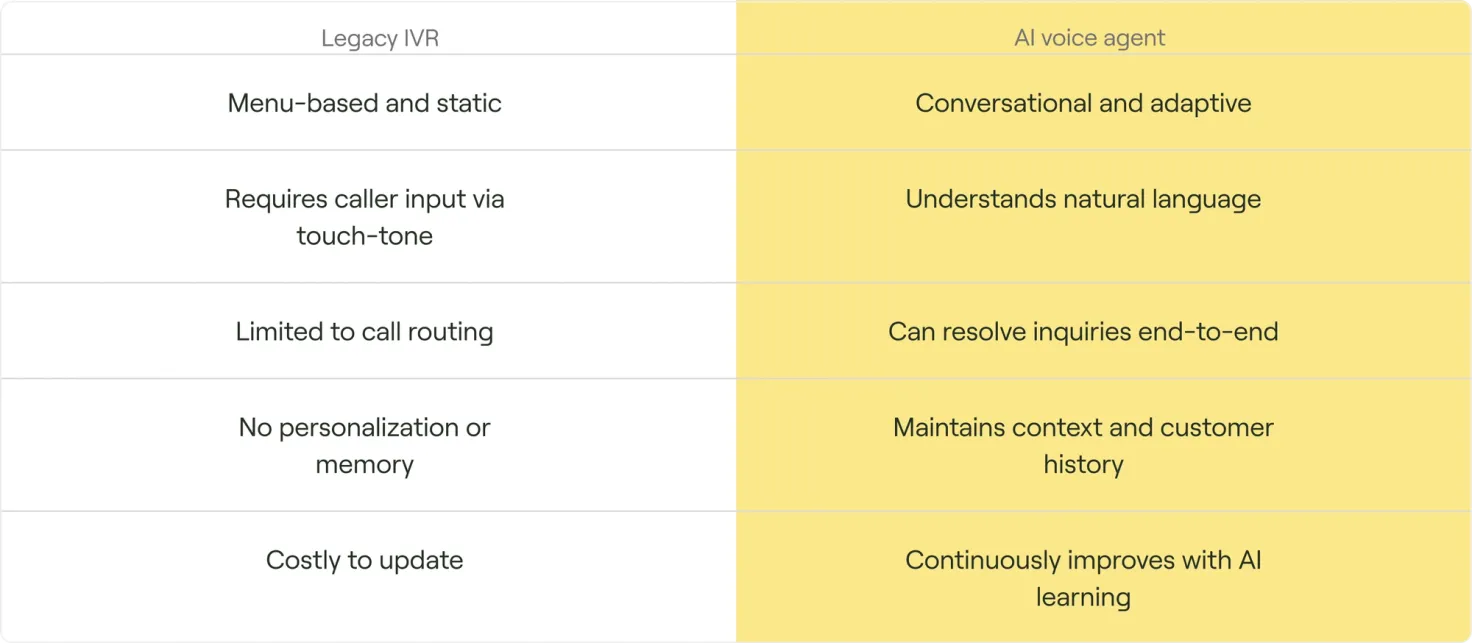
Legacy IVR (interactive voice response) systems rely on static menus and keypad inputs. They’re designed to route calls, not resolve them.
Think: “Press 1 for billing, press 2 for claims,” and so on.
While IVRs once improved efficiency, they now create friction . Customers get stuck in loops, have to repeat themselves, and often request a live agent anyway.
For insurers, they’re also costly to update, hard to personalize, and difficult to scale. The experience is rigid and disconnected from the reality of modern policyholder needs.
In contrast, an AI voice agent for insurance allows customers to speak naturally, asking open-ended questions like “Is my provider in network?” or “Has my claim been approved?” and get accurate, relevant answers instantly.
AI agents can do more than provide information. They can retrieve claim status, issue proof of insurance, and update account details, often without involving a human. They adapt to each caller’s intent, handle multiple languages, and improve with every interaction.
Managing high-volume environments like health insurance call centers or national P&C carriers , this is a game-changer for AI in customer communications for insurers.
In insurance, where precision, empathy, and compliance all matter, voice AI isn’t just a nice-to-have, it’s the new standard.
Let’s talk outcomes. AI voice agents aren’t just flashy tech—they’re most valuable when deployed against high-impact, high-volume workflows that insurers already struggle to scale.
Here’s where the best AI voice agents for insurance deliver meaningful ROI.
When deployed correctly, AI voice agents for insurance don’t just deflect—they resolve. They operate across channels, languages, and regulatory environments, while giving your team space to focus on high-value interactions that require human expertise.
Voice remains the largest volume channel in customer service, accounting for over 53% of all contact center interactions in 2024 . Historically, it has been the hardest to automate. That’s changing fast.
AI voice agents are already delivering results in high-volume, high-friction workflows, especially in insurance. Here are some of the most promising areas for insurers to focus:
Voice is no longer just a cost center. With the right platform and roadmap, it becomes a central part of your CX strategy , delivering speed, consistency, and scale.
And when done right, it’s not just about reducing effort. It’s a lever for retention, loyalty, and even upsell opportunities during key policyholder moments. And it’s quickly becoming the foundation of AI in customer communications for insurers, enabling scalable, on-brand, and personalized service at every touchpoint.

Choosing the best AI voice agents for insurance isn’t just about automating calls. It’s about deploying a secure, intelligent system your team can trust and manage.
Here’s what to prioritize.
Can your AI voice agent for insurance maintain memory across chat, email, SMS, and phone?
Policyholders often start a question in one channel and follow up in another. Without omnichannel context, your AI is flying blind, and customers are forced to repeat themselves.
Look for platforms that offer persistent, cross-channel context so your AI agent can resolve with full visibility, no matter where the conversation started.
Ready to find the perfect AI agent for your omnichannel strategy? Download the guide now and make an informed decision that will elevate your customer service to new heights.
Get the guide
To resolve real issues (not just answer FAQs), your AI agent needs access to backend systems. That includes:
Without these, voice AI agents can’t act on customer intent—they can only inform. And that’s not enough.

The best voice AI platforms for health insurance call centers and P&C carriers must be built for regulatory rigor . At a minimum, look for:
If your AI customer service platform can’t meet these standards, it’s not ready for insurance.
Voice automation in insurance isn’t just about understanding what’s said, it’s about understanding what’s meant. Your platform should handle complex, policy-specific questions like:
Look for platforms with advanced reasoning engines, not just keyword matchers. These systems should personalize responses based on context, policy details, and customer history. This is key to improving CSAT and first-call resolution.

Insurers shouldn’t have to rely on vendors every time they want to improve the customer experience. Your platform should empower internal teams to:
If making a simple change requires a support ticket, that’s a platform you’ll quickly outgrow.
To deploy the best AI voice agents for insurance, insurers need platforms that combine deep insurance logic with enterprise flexibility. It’s not just about answering the phone, it’s about resolving policyholder needs with speed, precision, and trust.
There’s no shortage of vendors claiming to offer “smart” voice automation. But most fall short on enterprise-grade support, insurance-specific integrations, or true autonomy.
Here are a few platforms that often show up in comparison lists:
Unlike script-based voice bots or isolated solutions, Ada is designed to power agentic customer experiences —where AI agents resolve, personalize, and improve with every interaction.
Insurers choose Ada because:
With Ada, voice is more than a contact channel. It’s a powerful surface for resolution, personalization, and growth, and a core part of modern AI insurance strategies that prioritize long-term CX transformation.
Building a great voice experience isn’t about adding another tool to your stack. It’s about building a system that can learn, improve, and deliver measurable value over time.
That’s why the best AI voice agents for insurance aren’t just plug-and-play. They’re part of a broader CX transformation strategy.
Here’s how leading insurers are starting small, proving value, and scaling their AI-powered voice operations with confidence.
Whether you're starting with voice or expanding into it, the goal is the same: smarter automation, lower cost to serve, and extraordinary customer experiences on every channel.
Building a great voice experience isn’t about adding another tool to your stack. It’s about building a system that can learn, improve, and deliver measurable value over time.
That’s why the best AI voice agents for insurance aren’t just plug-and-play. They’re part of a broader CX transformation strategy.
Here’s how leading insurers are starting small, proving value, and scaling their AI-powered voice operations with confidence.
Whether you're starting with voice or expanding into it, the goal is the same: smarter automation, lower cost to serve, and extraordinary customer experiences on every channel.
Policyholders don’t care how your voice experience is built. They care that it works.
That they’re heard. That their question gets answered quickly, clearly, and with confidence.
AI voice agents aren’t experimental anymore. They’re already helping insurers reduce call volume, improve service consistency, and make every interaction count without adding headcount.
But to make voice truly work, it needs to be part of something bigger—connected to your data, your policies, and your brand. It’s backed by the same platform, playbooks, and performance tools that power your entire automation strategy.
Because in insurance, resolving the conversation is just the beginning. The best voice agents aren’t just good listeners. They’re good employees.
Watch this exclusive on-demand session on how to make the case for upgrading from legacy IVR to next-gen AI voice agents and position your business for the future of customer experience.
Watch on-demand 


